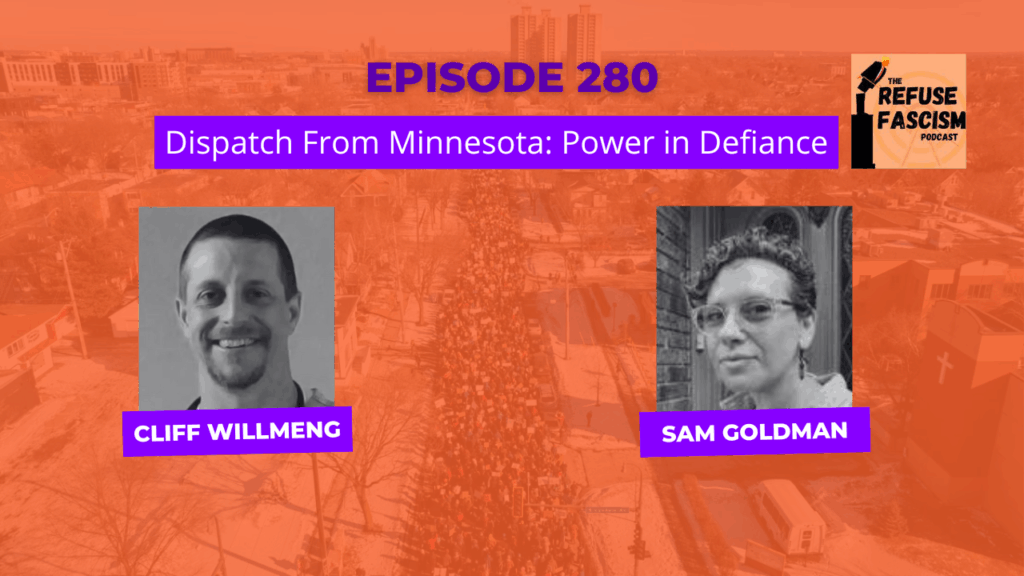
Episode 280
Sam recaps the latest developments as the regime continues to signal their plan to undermine midterm elections and anything that will impede their goal of ethnic cleansing.
Then, she speaks with Cliff Willmeng, Minneapolis resident, nurse and activist, about the crisis facing the Twin Cities: the occupation by ICE and other federal forces and the unprecedented resistance that the cities have demonstrated on all fronts to this fascist offensive.
Mentioned in this episode:
- Heather Cox Richardson: February 7, 2026
- Zeteo: This Week in Democracy – Week 55: Trump’s Racism Isn’t Distraction. It’s Policy
- The Marshall Project: ‘Why Is This Happening to Us?’ Daily Number of Kids in ICE Detention Jumps 6x Under Trump
- Children trapped in Texas immigration facility recount nightmares, inedible food, no school
To get involved, text REFUSE to 855-755-1314 or sign up online, follow @RefuseFascism on social media (@RefuseFashizm on TikTok) and our YouTube channel: @Refuse_Fascism.
Support:
- Subscribe to Refuse Fascism on Substack
- patreon.com/refusefascism
- donate.refusefascism.org
- Venmo: Refuse-Fascism
- Buy merch (Big Cartel)
- Buy merch (Fourth Wall)
Music for this episode: Penny the Snitch by Ikebe Shakedown
Episode 280 Dispatch From Minnesota: Power in Defiance
Sun, Feb 08, 2026 6:29PM • 59:17
Cliff Wilmeng 00:00
The community is powerful right now. It’s the people that are setting the tone. The politicians are not here for us. This is not something that we want to reconcile ourselves to. We don’t want ICE masked, anonymous gunmen to become a normal fixture of American life, they’ll abduct our neighbors or shoot our community members down in broad daylight. That’s not an option here, so we’re watching our backs. We’re protecting our neighbors, but the spirit here is like a level of defiance and anger that is tempered with enormous discipline. I have never felt anything like this.
Sam Goldman 00:54
Welcome to Episode 280 of the Refuse Fascism podcast, a podcast brought to you by volunteers with Refuse Fascism. I’m Sam Goldman, one of those volunteers and host of the show. Refuse Fascism works to unite all who can be united in mass, relentless, nonviolent resistance to drive the Trump fascist regime from power. This week, we’re sharing an interview with Minneapolis resident, nurse, and activist Cliff Wilmeng regarding the unrelenting campaign of terror from Trump’s ICE Gestapo in Minnesota and the many thousands in Minnesota directly confronting ICE’s murderous fascism, shock troops and the tens of thousands more who are organizing block by block so their immigrant neighbors can survive what’s being unleashed.
Before we get started, a quick thank you to everyone who rates and reviews the podcast, everyone who picks up our merch, supports us on Patreon and subscribes on substack. That support really does make this work possible. If you’re listening and you don’t do those things yet, now’s a good time. After listening to this episode, of course, please take a moment rate and review the show on Apple podcasts or wherever you listen. Pick up a sweatshirt, a t shirt, a hat from our shop. Become a patron for as little as $2 a month, or subscribe on Substack. It all helps us keep building this platform and getting these ideas out where they need to go. But first, we need to talk a bit about the overall terrain right now.
This week, we have watched the supposed “guard rails of democracy” tremble and shudder — election integrity, the power of the press, the court’s will to check abuses, the steady hand of the civil service, all have come under attack, and all have shown either their vulnerability, or worse, their willingness to facilitate fascism. We see the gutting of the Washington Post by its Trump adjacent billionaire owner, Jeff Bezos. Schedule F is about to be finalized, enabling the regime to get rid of another 50,000 federal workers. The Fifth Circuit has rolled out the red carpet for the fascist anti immigrant agenda.
But above all, it is the regime’s concerted blitz against the integrity of the midterm elections that reveals their hand. For most Americans, elections are the essence of democracy. In theory, the Constitution shapes elections as a two fold check on the power of the federal executive: 1) The results of the elections are supposedly an expression of the people’s will, and 2) The management of elections by the states prevents the President, the current administration, and the federal government, broadly, from manipulating the process.
The Republicans have been gerrymandering and intimidating their way to power for decades, but now Trump is openly attacking the very concept of states operating elections, claiming without proof that every election, even the ones he won, have been rigged against him. In a podcast released Monday, he has now begun to demand that the Republican Party take over or “nationalize” elections in 15 states. The net result would mean Trump’s fascist regime directly controlling one of the key checks on federal power: the authority of the states to manage elections. His justification is that immigrants “were brought to the United States to vote illegally.”
It’s one of the regime’s most explicit expositions of the great replacement theory that “they are replacing white Americans” with supposedly pliable brown people, and it’s coming straight from the mouth of Trump himself. On Tuesday, he doubled down on this, speaking directly to reporters. Leavitt drew attention to the Save Act, which Republicans are trying to ram through Congress, which would be by far the most restrictive set of voting measures ever proposed. Steve Bannon clarified that the plan is to send ICE agents to surround polling places to do exactly what they’re doing now in Minneapolis; intimidate or detain anyone who isn’t white and threaten or even.
Kill anyone who stands up to them. Tulsi Gabbard seized voting machines from Puerto Rico, a territory where people aren’t even able to vote in presidential elections, in an ever more ridiculous attempt to find a shred of evidence of impropriety that would justify Trump taking direct control over the election process. The midterms were not ever going to save us from fascist consolidation, but now it must be clear that they themselves will be an attempt to lock down their fascist future.
Trump has had his mask off for some time as a genocidal white supremacist, and this was continued this week. Trump posted a video that featured an AI generated video of Barack and Michelle Obama onto the bodies of dancing apes. For 50 years, such overt racism has been kept confined to the sections of the Republican Party and the “conservative movement” that operate in the shadows or behind closed doors. Portraying Black people as apes is the kind of thing that has ended careers, rightly so — that has elicited mealy mouth condemnation from people in power.
But Trump has loudly said that this is who he is. He has said this again and again. He has screamed it and shown it through his actions. His official spokesperson called the backlash fake outrage. He has said himself that it wasn’t a mistake. While the post has been taken down, Trump has adamantly refused to apologize. We need to be clear that this is not some excess, not some slip up, not dementia. This is who Trump is, who he has always been. It is who this regime and MAGA are. They are doing everything they can to make blatant white supremacy socially acceptable again, to project it from the highest office in the land. If we do not stop this regime as vile and grotesque as this is, this is just the beginning.
Now let’s turn to the regime’s assault on the rights and lives of immigrants. As you’ll see, they’re connected. The attacks on immigrants are the battering ram and the linchpin of the entire fascist program. Over the last month alone, more than 71,000 people were held in 224 immigration detention centers — concentration camps — across the United States. This is more than double the number that existed before Trump took office, and 104 more facilities than existed prior to Trump retaking office. This is mass incarceration of a targeted population designed to terrorize, disappear and dehumanize, and it is accelerating. The regime is buying up industrial warehouses across the country for warehousing human beings.
Plans are underway to convert these facilities into ICE detention centers capable of holding more than 80,000 people at a time. Six people have already died in ICE custody in just the first three weeks of this year. The Minnesota to Texas detention pipeline continues, ripping people out of their communities, severing access to lawyers, isolating families, and making collective resistance harder — giving us a glimpse of what’s ahead if we do not stop this. And it’s about to get even harder for immigrants in this country to receive even the most basic due process.
A new interim rule governing the Board of Immigration Appeals guts what little legal protection still existed. Under this rule, immigrants now have just 10 days, not 30, to appeal a deportation order. Unless a majority of the BIA affirmatively votes to hear a case, it is automatically dismissed within 15 days. This is engineered denial of justice, as immigration attorney Craig Reyes warned: This will flood federal courts, and more importantly, it will force more people into ICE detention faster, with fewer avenues for release. We need to be clear: Speed is the point, confusion is the point, crushing resistance through procedural violence is the point.
This past Friday, the Fifth Circuit Court of Appeals ruled that the Trump regime can lawfully strip people in deportation proceedings of bond hearings, directly defying the judgments of more than 300 federal judges. As constitutional scholar Steve Vladeck explains, now, “the government can indefinitely detain without bond millions of non citizens who have been here for generations, who have never committed a crime, and who pose neither a risk of flight nor any threat to public safety.” On February 3, more than a thousand people packed a surprise city council meeting to oppose one of these new warehouse conversions, the establishment of a modern concentration camp, in their community.
Heather Cox Richardson in her Letter From an American on Substack shared the following: One of the speakers reminded the Council of Ordruff, the first Nazi camp liberated by U.S. troops. On April 4, 1945 he said, “The U.S. Army brought the leading citizens of Ordruff to tour the facility, which turned out to be part of the Buchenwald network of concentration camps. A U.S. Army Colonel told the German civilians who viewed the scenes without muttering a word, that they were to blame. One of the Germans replied that what happened in the camp was done by a few people, and you cannot blame us all. And the American who could have been any one of our grandfathers, said, this was done by those that the German people chose to lead them, and all are responsible. The morning after the tour, the mayor of Ordruff killed himself. Maybe he did not know the full extent of the outrages that were committed in this community, but he knew enough. We don’t know exactly how ICE will use this warehouse, but we know enough. I asked you to consider what the mayor of Ordruff might have thought before he died. Maybe he felt like a victim. He might have thought: How is this my fault? I had no jurisdiction over this. Maybe he would have said: This site was not subject to local zoning, what could I do? But I think when he reflected on the suffering that occurred at this camp just outside of town, that those words would have sounded hollow even to him, because in his heart, he knew, as we do, that we are all responsible for what happens in our community.”
This is the moment we’re in. This machinery gobbling up our human siblings doesn’t stop with adults. Family detention centers like in Dilley, Texas now hold hundreds of children, many of them us residents, seized, not at the border, but from homes, from schools, from courthouses and at routine check-ins. Children young enough to still be breastfeeding in prison. The conditions there are grotesque. Hundreds of children languishing as they’re served contaminated food, receive little education and struggle to obtain basic medical care. There are now two confirmed cases of measles in an epidemic engine. ICE detained nearly 3,800 minors in family detention from January to October. An analysis by the Marshall Project, using data from the Deportation Data Project, found that ICE has been holding around 170 children on an average day under Trump 2.0, and that number is an undercount.
It does not include the recent surge of arrests in Minnesota, children held by Border Patrol or children in the custody of the Office of Refugee Resettlement, where kids are detained without a guardian. At least a thousand children were held longer than 20 days in violation of a court order limit on child detention. At places like Dilley, family detention has returned on a massive scale. While family detention existed under Obama and expanded during Trump’s first term, what’s different now is who is being detained. Many of these children are U.S. residents, seized not at the border, but from their homes, schools, courthouses during routine immigration check ins. This is what their law and order looks like.
This is how repression scales: first immigrants, then dissidents and anyone who refuses to comply. When we say immigrants are the battering ram, we mean this is how the regime smashes through the last restraints. Immigrants are the first people they come for, because they think they can get away with it. Strip rights here, lock people up there, normalize concentration camps here, break the law there, and once that wall is down, they drive straight through the rest of society. When we say immigrants are the linchpin, we mean the whole fascist project depends on this — the camps, the surveillance, the raids, the disappearance of due process. This is the machinery they’re building to rule, tested first on immigrants, then expanded to everyone who won’t comply.
This is how fascism works. You start with the people you deem subhuman, you declare that no one will defend, and you end with a society ruled by fear, by force. If this is allowed to stand, it doesn’t stop here. Defending immigrants isn’t a side issue, it’s the front line. Stopping this means stopping the whole regime before this becomes locked into place, because there is no living with this. There is no stopping at piecemeal. The whole fascist regime must go now, before this machinery locks fully into place.
Before the interview, I want to lift up some really important student resistance that we’ve seen this week. Massive protests have disappeared from the news, but something new and beautiful is developing. High school students across the country are walking out of school to protest the actions the regime’s fascist foot soldiers. A quick search brings up dozens of local articles. You can see that students walked out everywhere, from Cherry Hill, New Jersey to Brevard County, Florida to Seattle, Washington, from Corpus Christi, Texas to Brentwood, Tennessee to Sharpsburg, Georgia. In some places, it was dozens of students, in others, hundreds. Over a thousand came out in Lincoln Nebraska. In Napa Valley, California, two thousand came together. In Los Angeles, it seems over 12,000 students took to the streets. In some places, schools passively supported their students, while elsewhere, students were threatened with repercussions.
The state governments of Texas and Florida took it upon themselves to try to quell these walkouts. For the first time since Trump returned to office, high school students have taken the lead in manifesting real resistance to the regime. Over the course of the past few weeks, we have seen college and high school students gathering their strength and making themselves heard, demanding an end to the fascist assault on Minnesota and everything it represents. Yet the nationwide news coverage of these events is categorically absent. There is one USA Today article from early in the week that collates some of the local reporting, but this should be front page news everywhere.
Overwhelmingly, ICE OUT! was the central demand. Some focused on the events in Minneapolis, while others rallied around members of their own communities that had been taken. In many places, students connected ICE’s action to the fascist regime in the White House. Chloe Freeman, a junior at La Quinta High School in Palm Springs, California, told the Desert Sun: “I think we’re headed toward a period of fascism in America, and I think it’s important for young people who have a voice to speak up against things they think are important.” These actions peaked on Friday this past week, but there were walkouts somewhere every day of the week, and they don’t seem to be stopping. If we are to succeed in driving this regime from power, the energy, vision and fearlessness of students must play a major role. People of every generation need to take heart from these protests.
Every attack on these students must be met with more protests, and these protests definitely need to scale up. Most importantly, the focus of these actions should be increasingly drawn towards the one viable, unifying demand that could change the course of history in this moment. And you know what that is: The Trump fascist regime Must Go Now! So with that, here is my conversation with Cliff.
We are talking about Minnesota, and lessons that we are learning together from the people of Minnesota, from what the regime is unleashing on the people of Minnesota. It is in that spirit that I am so glad to bring to you this week, and hopefully the following week, more voices from on the ground. Today I’m going to be speaking with Cliff Wilmeng. And Cliff is a South Minneapolis resident and nurse. I want to welcome you, Cliff. Thanks for joining us.
Cliff Wilmeng 17:38
Well, great to be on the show.
Sam Goldman 17:40
First of all, I was hoping that you could kind of talk to us in broad strokes. What is happening in the Twin Cities? We know two U.S. citizens have been murdered in the streets in recent weeks. We know that people are staying inside, frightened, not going to work, not going to school because of fear of ICE. We’ve heard about the empty cars appearing on the streets and highways as ICE kidnaps their occupants. I’m wondering: What aren’t we hearing about? Can you give us a sense of, really, the scale of this attack on Minnesota?
Cliff Wilmeng 18:14
It’s a great question. To be blunt, I don’t even know what all is taking place. There is so much activity both on the side of ICE and the federal government, the local political circles, which, of course, in Minneapolis, are mainly Democratic Party. The various police forces, like the Minneapolis Police Department, as well as Hennepin County Sheriff, which is the county sheriff here, and then all the way across every single community here, which you’ve probably heard at least something about, there is just an enormous acceleration in grassroots organizing, geographically from block to block, but also in terms of providing support for people, providing eyes on the ground to observe ICE and also to… everything from medical care, medical considerations, to food distribution, and likely a thousand more working groups and aspects that wouldn’t even occur to me right now. But it’s happening just that fast, not only in the communities, but also in the workplaces. This is stuff that is moving at such a pace that it’s hard for even the residents to keep up with it. That’s pretty much where we’re at right now.
Sam Goldman 19:22
I really appreciated that you also spoke to he resistance that we’re seeing. There’s the attacks, and then there’s the resistance. We’ve seen beautiful gatherings of people singing in frigid air as you were talking about people doing more of the ICE watch type of activities. I was watching a video, I think today, a Ford Fisher video of some people in their car doing some patrolling, watching ICE, and then ICE pulls their guns on these observers, forces them out of their car, and yet people are still signing up in bigger numbers to participate in these watches. People are trapped in their homes, afraid to go out immigrant families who you know can’t go grocery shopping, can’t get basic supplies, it’s truly inspiring and breathtaking. I was wondering if there’s anything regarding that that strikes you as not being talked about enough, or that you think is worthwhile for other people to be paying attention to that aren’t in Minnesota.
Cliff Wilmeng 20:22
Where do I begin with this? I’m a nurse. I’ve got two kids here and a wife, I’ve got a family here. But I’ve been a political activist pretty much all my life, since I was probably 15; in anti-imperialist work in the 80s, and I was in Seattle during the World Trade Organization protests. I’ve done labor activism as a rank and filer and as an elected officer for 25 years. I’ve never seen anything like this. This is something that has taken a form and pervasiveness and a level of organization that I think is entirely unique within U.S. history. We had some preparation with Minneapolis.
We had the whole George Floyd, big uprising that just took place, like five years ago, and because of the size of that, the response to the killing of George Floyd, the neighborhoods all, to some degree, started to organize neighborhood committees, just to protect the neighborhood, to make sure the grocery store was doing okay, to check on the various neighbors and get people what they need, and to kind of facilitate that. So the groundwork was somewhat there when this took place and ice came to Minneapolis, but nothing compared to the level it is right now, where basically the neighborhoods have taken upon themselves to develop communication structures, to start identifying the people who are the most vulnerable.
Some folks might not really be talked about all that much in the national press, but it’s not just people that are scared to come out, to go to work or to get food, but there’s people that need medical care, that are nervous about going into the hospitals. So you get requests for somebody who might be like a midwife to literally deliver their children at home; their child at home. The crisis, it’s about as harsh and severe as you could possibly imagine there. Obviously, with the gunning down of Alex Pretti and Renee Good, it just amplified. It’s so much more. But people have been undaunted. It just seems that the more severe the punishment and the more severe the repression and antagonism and the violence on the part of ICE and Border Patrol, the more people turn out. That’s not an equation that I’ve seen a ton in my life. That’s for sure. Not to this level.
I don’t even know really where to begin, because I’m in the South Minneapolis area right here, I could sit on various text threads and discussions all day long, to the tune of hundreds of pieces of communication, depending on what you’re interested in, to depending on what your level of risk is, and, like, where you want your involvement to be. This is starting to look a lot like something I would read about in a history book for like, the 1934 Teamsters strike here, or like, Civil War Spain. In some tiny little fashion, where you have the community… we’re all meeting each other right now. The restaurants or the local businesses, a lot of them are locked, so you have to knock on the front.
They need to be able to recognize you to get in there. So we’re watching our backs. We’re protecting our neighbors. There’s just an enormous learning curve that’s taking place with it. But the spirit here is… I don’t have the words quite to describe it. It is outrage and a level of defiance and anger that is tempered with enormous discipline, given everything, that I have never felt anything like this. A lot of times several weeks into big protests or something like that, usually the mechanisms come into that community, whether it be an urban Black uprising or whether it’s what happened Seattle in 1999, the various forces that ostensibly are friendly to the movement are employed to come in and put their arms around it, put a bow on it, and get it to bed. That has not worked here. It’s not that it’s not trying, but the community is too powerful right now. It’s the people that are setting the tone and the curve here.
The politicians are not here for us. Jacob Frey, his high point in all of this was when he swore that first week, and he’s not even using profanity anymore. The politicians are checked out. They’re all wrapped up into the political circles here. Now the local police is basically running security for ICE. The Hennepin County Sheriff is now running security for the Whipple Detention Center, which, of course, frees ICE up to commit more people into the neighborhoods, in the workplaces. What you’re getting here and what you’re seeing on the news — and I could sit here in my living room and listen to the news and start to draw a conclusion like: Well, you know, maybe Minneapolis is tired, people are fatigued, they want to get back to normal life to some degree, and you walk out the door and it is just live.
Graffiti is everywhere. There’s bands, there’s rallies. You go down to those memorials for Renee and Alex, and they are just so painful and powerful. But the whole local communities around there are rallying — everywhere. Schools are organizing protection efforts, and it’s just everywhere you turn that’s just kind of the feel for it right now. I do believe that we are tired. I’ll say that. The tempo might not be what it has been. This is going through a rebranding phase, with Tom Homan being sent out here, and suddenly Mayor Frey and Tim Walz and Donald Trump are all tweeting something that is awfully familiar sounding. I think the script has gone out, but it just doesn’t matter. The people are just too present and too strong right now. We’re the ones that are driving this.
Sam Goldman 25:56
That’s really, really helpful, how you broke that down, and you know, the sustained quality of not only the defense effort, but also the amount of protest and refusal and non-cooperation that we’ve seen. It’s just impressive. We haven’t seen anything like this. It’s funny, you’re talking about all these networks that have created in these chats, and you listen to some of these fascists on the outskirts, not those in power, trying to get the FBI to investigate, that it’s immediately suspect, that there would be neighbors helping neighbors — that there’s some nefarious funder — it’s not possible that people would just care about each other, that people wouldn’t want school children targeted, they wouldn’t want grandmothers targeted, that doctors would volunteer their time… What?
It’s just such a different world view, and I think that in the face of everything that is bigoted and cruel and wrong, the majority in the Twin Cities, is showing goodness and decency. There’s something very precious about that. One of the ways that’s expressed itself, in a way that many have taken note, is with the general strike, or, what was called a Day of Truth and Freedom, I believe. I was wondering if you could talk a little bit little bit about how that came together, and maybe, who participated in this. There can be legal challenges with some of these things in terms of unions. Maybe you know how were the legal challenges dealt with? Unions have typically interpreted law to forbid what are called political strikes. I wanted to get an understanding.
Cliff Wilmeng 27:45
Yeah, absolutely. I’m a rank and file union member. I’ve been a member of three different unions in my life, and I’m very familiar with the American labor movement. The general strike is something that has not been employed in a very long time. The surface reasoning for that is, yes, a general strike and a political strike has been illegal since the 1940s. Somehow, from the 1940s all the way until 2026 it doesn’t seem to matter who’s in the White House and who occupies the Congress, that Act just somehow lingers on. When we start talking about a general strike, that is usually the first thing you hear: Well, it’s illegal; We can’t do it, it’s illegal. While I respect that, I understand that, I understand that unions… doing something significant… there’s a reason a general strike is illegal. It’s because it’s extremely effective. It’s a major flex of latent power that just sits there.
You know, you pull off a real general strike, and you start to get back into the muscle memory of the American working class and all of the immigrant communities that came to this country, and to start to show how dependent these rich people are on us — how totally helpless they are without it — you’re risking an infectious process. Because once people start to get a taste of the power that they’ve been denied or that’s been obscured from them for generations, they might start to remember some things and start to take some decisions that might not sit well with corporate American and American capitalism itself.
That’s kind of the way the narrative goes, is that you can’t have a general strike because it’s illegal. The union’s going about it, we get sued, and then they’re gonna get bankrupted, and then they’d have to fire all their important staff and all that kind of stuff. The fact of the matter is, if we obeyed the law in the 1930s nobody would know what a union was. The labor movement in the 1930s was breaking court injunctions every five seconds. I mean, the whole UAW sit down strike across Flint, Michigan, the Toledo general strike and the Seattle general strike were never approved by the law. That’s just a farce. It’s laughable. But most union members aren’t taught that kind of history.
In those moments, you had a very different kind of organizing, an industrial organizing on a very different basis than just that we’re going to get a couple predictable, subpar raises, and we’ll stave off the worst concessions. That’s what’s considered a victory these days. So you had different situation on the ground, and the militancy of the workers were different back then, because the expectations were different, and, frankly, the leadership was radically different back then compared to what is passable now. What took place in Minnesota was somewhat hedged and cautious. It didn’t sweep into Minneapolis with this enormous, violent offensive of what feels to us like a paramilitary organization coming through the communities. It took place a couple union locals at a time.
That being said, it got legs quick, because the community was ready for it. I can say that maybe the cooler heads that would have talked other efforts, or similar efforts into something a little less edgy, maybe a few months ago. The momentum of the community is awfully undeniable. The momentum and the anger of the people in the unions are right there. It came together pretty fast, in kind of a coalition. I was not part of organizing that, but I’m very close to a lot of the folks that were. It started off with, like, the Buy Nothing thing, don’t go to school. The students here are amazing. The young folks here, and the leadership and tenacity that they’ve had are a whole element that I think isn’t getting enough attention for its own reasons. They have just been fierce and undaunted.
So that was another element as well. There was going to be mass student walkouts no matter what. Within the process of that, a significant amount of unions did not sign on to a general strike. They signed on to participation in the day. So we all got the notice that said, you know, look, we can’t participate in a general strike, but don’t buy anything, and if you’re not working, great. There was that march just a couple Fridays ago, which, of course, I think, had probably between 75 and 100,000 people in it, where it was 10 below zero. How do you deny that? That too, was an enormous success, and it also set a new expectation, because if we know that we can’t fight fascism with an online petition, the Democratic Party is utterly flat footed.
Let’s face it, the Democratic Party wants ICE. That’s the talking point. They just want it to look nicer. Nobody minded ICE when Barack Obama was deporting a few million people. Now, the perfume is coming out, and they have to put the whole genie back in the box. From our position, this is not something that… it can’t be muted or worked with, or… the cosmetic changes with body cameras? Are you kidding me? T hey’re already wearing body cameras. They don’t care.
Sam Goldman 32:42
They can record themselves murdering you. [CW: Yeah, they’ll just put it straight on TikTok.] It makes such a difference with the police, right? We don’t have police brutality anymore.
Cliff Wilmeng 32:53
Right, yeah. That that disappeared as soon as that superficial idea came around. Being completely sarcastic. But, we’re in a situation here where you have two political parties that are absolutely in favor and have helped build and fund this organization, not to the extent that it is now, but they’ve lived alongside paramilitary organizations in the Department of Homeland Security for decades. While those of us that had an inkling of what those organizations could eventually be used for, and were trying to sound the alarm for the last 20 years, you know, only to be ignored… well, here we are. Here we are. It’s no longer a screenplay, it’s live. The options that we have in order to combat this and defeat it, which is our purpose — we’re here to defeat this.
This is not something that we want to reconcile ourselves to. We don’t want ICE, masked, anonymous gunmen to become a normal fixture of American life; abduct our neighbors or straight out, shoot our community members down in broad daylight. That’s not an option here. To the extent that we’re trying to make a bargain with that, it’s just not cutting, and it’s not rising to the historic need. So back to the main thrust of what I think you were saying, that general strike is something that needs to be propagated, and it needs to be discussed, and the union leaders need to take initiative on it. Certainly, at very minimum, they can call for national conferences to even discuss a general strike. That’s perfectly legal. The apparatus to organize it is already there.
We’ve got 14 million members. We have labor councils in every state and in every major city around the country. It’s almost like we could create our own new working class party with almost like the flip of a switch. It’s all right there. Imagine the money we would save by not sending it off to somebody else. But that’s the question, then. It depends on your interpretation of the end game of this regime, where it’s headed. Donald Trump, or even post Donald Trump, what’s really necessary for the American people and the immigrant communities here, whether it be this flash point in Minneapolis, or whether it be the complete bankruptcy of this entire system that we’re suffering under for a very long time, and we’re so almost every day.
Sam Goldman 35:10
Absolutely, I think there’s a big, unfortunately, still ongoing debate of what it is that we confront. That has everything to do with then what you think the solution needs to be. If you think this is the most extreme version of a pendulum swing, then what you’re going to do is going to be tethered by that idea. [CW: It’s gonna be informed by it.] Right. If you think that, for instance, ICE is a force that can be reined in, then that’s going to shape what you do. I think people don’t want to believe their eyes. They don’t want to believe their eyes, to believe their ears.
They’re saying it’s fascism, and yet, part of them doesn’t want to believe that they’re right, because what does that mean about how could it happen in a country like this? in many people’s minds, right? So I think that there’s a lot at play in terms of shaping even what people within positions of power, whether it be unions, business, wherever it is, what they feel is the imperative of the time. There was a certain proof of concept that day, provided, we’ll have to see where it goes, obviously, but I did feel that you saw how many people felt it, and were like: Yes! That was, to me, a key ingredient, but we’ll have to see. A friend in Minnesota had texted: We can’t live in our liberal bubble state anymore. They’ll come here and punish us.
We know, based on ICE’s new budget, a budget beyond most militaries in the world, and then more money coming in after that, in this network of planned concentration camps around the country, all these warehouses that are being gotten, it’s really just a matter of time before this scene is replicated against other major cities. My question is: What do you want people in other areas to understand about this dynamic?
Cliff Wilmeng 37:11
There’s at least two components to it. For one, how serious are we talking about? And again, what is the end game? Because Greg Bovino came and went, but Greg Bovino is not the master of ceremonies here. He’s just a ground level goon. Tom Homan is a bit more adept. He has bipartisan appeal. He has already cut his teeth in the human export business out of this country, and he’s surrounded by an entire group of people. Kristi Noem is one person. She’s a half witted fascist, if that. She can barely go a 24 hour period without looking like a fool, and her level of believability, I mean, unless you’re just in a complete denial, it’s a running joke. Somebody ought to tell her if she wants to commit to a real career in propaganda, the whole idea is you’ve got to convince people and confuse your opponent.
All they’re doing is exposing themselves. That’s not effective propaganda. You’ve got those kind of upper echelon people like Noem and Bovino and, frankly, Trump himself, but the people that are really pulling the strings, and the people that do have an endgame and that have been preparing the ground for it for many, many years, and that sit around in giant think tanks that you and I don’t even know where they exist, and have access to international networks of power and wealth, technology, weapons, they do have an end game.
Again, it’s one of those things where if you would have told me a few weeks ago that masked gunmen would be gunning down people in broad daylight in the residential neighborhoods of Minneapolis as a paramilitary, frankly, I would have said that’s not the best way to go about organizing a deeply rooted right wing. You’re throwing for the end zone on the first play. But that’s exactly what happened. They came in here and they wanted to wield that violence and make an example out of Minneapolis, ostensibly to establish themselves and to… I don’t know if they wanted to provoke much more direct or physical response to that from the community here, but they got nothing.
They antagonized an entire state to action, and in the process of it, not only catalyzed a real level of community organizing that we haven’t seen in a long time, but also the response then percolating back into the workplaces and the unions and the schools and all of that kind of stuff — a real mobilization that is not containable even by the local political apparatus. When Jacob Frey, like when people are asking him, like: Why aren’t the Minneapolis Police Department… why aren’t they protecting us? Jacob Frey can’t say it out loud, because it exposes the whole machine. The police, they’re for ICE! They’re on their side. So, if Jacob Frey were to ask them to come and protect the communities, the police would likely tell Jacob Frey: Absolutely not. You can’t even call the question.
The police union out here wrote a letter of support to ICE weeks ago. On the other side of that, what has also been exposed is the fact that the communities can come together and resist this. It’s certainly not work, as we’ve all seen now that is without risk. The people here are wondering, when they’re reporting on ICE and observing ice, whether that’s going to be their last day on earth, because that’s the stakes for this. What do you tell the country out of that? I mean, take a look at it. It’s funny, I’ve invited friends into Minneapolis just so they can come and be affected by it, because I can’t explain it over the phone.
But, like, when you’re walking down the street here and you go into a business, the first thing you ask everybody: How are y’all doing in here? And they say: Oh, we’re doing okay, considering the circumstances, and we got this and that, but everybody is taking care of each other and looking out for each other. The real takeaway is that that we are being reminded of what resistance really means at such a late, ugly stage in this system, and with all of the terror that is going on in this world and the global ecology and the crisis around that, and it’s like: Man, the bell is ringing. The time is now, and I can’t separate in my own mind, the extreme measures that the United States government is not just prepared for, but now enacting and carrying out, and the desperation of our own population, economically and environmental — the whole area that those two forces seem to be informing each other.
So we’re not without resources here. We’re not without creativity, and we’re not without power. That’s for sure, that we know. I guess it’s just kind of coming to face this moment the way a lot of communities of color have had to deal with it around the globe, and a lot of countries have had to deal with it around the globe for very, very many years. But you’ve got to kind of get your head around it for a minute, because it’s not until you see these guys driving around in their cars or pulling their guns and standing right in front of your windshield that you can really integrate the full scale of what’s going on here
. That’s probably the most roundabout way to answer your question about it, but is fascism coming to America? If this isn’t what it looks like… To me, it feels just like that, except for weaponized by technology that the fascists in 1930 would have just salivated at. How do you prepare for it? I don’t know. You have to pay attention, though. Minneapolis, in a way, I think, is, is training ICE and training the Department of Homeland Security, but it’s training the population here at light speed. So, you know, therein lies the crux of the matter, I suppose.
Sam Goldman 42:49
I didn’t think that that was round about at all. Some of the things are definitely worth lifting up again in what you were saying is the complex reality that we face and the urgency that we confronted, the level of unity that’s required, the coming back stronger in the face of repression, the finding the ways for everybody to be using what they have to get, what we collectively need. All of those things are really important. What you’ve repeated or come back to a few times on that we have the power, instead of looking elsewhere, I think is really essential. I guess it was last week, where Bovino was going to be replaced, he’s not in Minnesota anymore, and there was — I don’t know what it was like in Minnesota, but — everywhere else, there was jubilation.
It’s done. This chapter’s over. And as you were saying: Who did they bring in? They brought in Tom Homan, the man who said: Oh, don’t worry, we don’t need to do family separation. We’ll deport them together, who oversaw the massive ripping apart of families, thousands of immigrant children from their arms of their parents. Over, like, 1,300 still haven’t been reunited, and yet he is like this gentler force? like, what? He’s more legitimate? It boggles my mind. Then you were talking about Frey, when he was saying… because I think a lot of people thought that when Walz deployed the National Guard, they thought that he was going to be forcing ICE to leave, but then Frey was saying that they can’t physically stop the federal government because they’re outgunned, and can only legally pursue them, but also cannot imagine what will happen if when they ignore court orders.
It just shows the limits of what relying on the Democratic Party to resolve this crisis, where that will take you. And so I really appreciate that. Then you had the Trump regime, through Bondi, offering to draw down forces in exchange for voter rolls. And yet, they keep acting — they being Walz — this is politics as usual; We’re gonna work together; We’re gonna come to a more amicable solution. Which, as you’re saying, you know, seems to be that they’re finding ways to use their forces so that there would be less ICE. I’m trying to figure out, how are they calculating?
Cliff Wilmeng 45:22
It’s amazing to me, quite frankly, because I think that what it honestly illustrates is that the American political class, they haven’t had to confront a real social movement in this country. I mean, there’s been lots of heroic efforts to make lots of changes in this country, but they haven’t confronted a real movement in generations almost. When I say a movement, I’m gonna be specific here: something that is politically independent, it is not part of a political party, something that understands that the system itself needs fundamental change.
And every single movement across the history of this country has understood that because this, you know, the system is not broken, it’s fixed. It is fixed. It’s operating according to design. Every single movement at some point realizes that in order to change the law, you have to break it. It’s different in Europe. There are general strikes there. There is a stronger working class consciousness there, and that informs a more sophisticated political class. Whereas, in the United States, they have not had that level of defiance and independence to confront them. So it’s produced, in my opinion, an enormous alienation from regular people.
They don’t have to wrestle with these questions, and they live in very insulated circles and networks. So the solutions to them, they sound agreeable, or they sound okay. I mean, like the Democrats are about to run Amy Klobuchar for governor. Why not have just AIPAC come in here and inherit, you know, the state of Minnesota? What does she have to offer? This woman cannot speak about any she doesn’t know what the price of groceries are. She’s a free market capitalist political maneuverer. What sounds right to Amy Klobuchar… when she gets the script to speak, it makes sense to her, because that’s what her little inner circle agreed to, and it makes sense to them.
So of course, you bring Tom Homan in here, because Tom Homan was Barack Obama’s guy. But Tom Homan gets here, and the first thing he starts talking about is creating a database to monitor and to go after the organizers of the community. I mean, he’s not even talking initially about the detaining the worst of the worst. What the hell does that even mean? The worst of the worst are all in Epstein island and in Washington, DC. He stepped it up verbally, almost right upon getting here — that this is going to expand, not only to as we all knew it would, you know, the most marginalized and vulnerable communities, but then any of those people that start stepping up to protect those groups. To me, that’s what it comes down to. Nobody here believes the Democrats are going to save us. If I told somebody that they would look at me like I was insane.
They might be drawing their own conclusions based on that, but none of the institutions… the unions, honestly, are flat footed with this stuff. They’re not showing the leadership that they should. Where the hell are they? For one? Where is Sarah Nelson? I haven’t heard her or seen anything from her in a week — the one who single handedly with her, all the airline attendants defeated Trump’s original government shutdown by threatening a work stoppage and grounding all the airplanes. I mean, how long did that take? 24 hours? The Democrats had been at it for two weeks, she took the momentum that and said: Yes, we need a general strike. But now’s the time.
And all of these institutions that have been atrophied, I’d say, by poor leadership at best, and have kind of gotten by, raised funds, done the superficial amount of work, had the social media presence and showed up in minor ways, they’re just not equipped politically for this sort of thing, this sort of moment, and so, you know, we’ve naturally had to take matters into our own hands. There’s a lot of illusions, and I’m sure I’ve got a couple myself, that somebody is going to come in here and do it for us… but the National Guard being called out here. I mean, we should know our history. I mean, my goodness, when I was arrested in Seattle protesting the cabal of corporations known as the World Trade Organization. I wasn’t arrested by the police, I was arrested by the National Guard. They were called out by the Democratic mayor at that point. S
o we should try to remember that a little bit. I recognize that there are working class men and women from all over the country that don’t have any stake whatsoever in the real machinations of global capitalism. But my god, you know, when they came out for George Floyd, those were live rounds that they had, and they can get pointed in all kinds of directions. Right now, you know, you don’t really see the National Guard here. If you go down to the federal detention center, they’re backed off by a good several hundred yards. There’s a few, maybe six or seven personnel carriers down there. They’re wearing the obligatory yellow vests to designate them as Minnesota National, or soldiers, versus federal soldiers.
But the Hennepin County Sheriff, I mean, they arrested people just last Friday who were trying to protest and to get in the way of these raids of ICE into the communities. None of these forces, any of these police forces, they don’t mind if you sit there and complain. They don’t mind that. We could do that for the rest of time, just so long as ICE gets into these communities and can grab people out of their homes and and their cars… The community interfering with that, the operations of ICE that you start to see even the local police force. I mean, Minneapolis Police Department arrested almost 80 people just last Friday as well, who were banging on drums outside of an ICE hotel.
So, yeah, who’s going to come and save us? The Sierra Club? Beings from Alpha Centauri? Amy Klobuchar? I don’t know. I mean, I’m from Chicago. I’ll tell you that Chicagoans are some tough people. These folks are the most polite human beings out here. You know, the Minnesota passive aggression thing, and I’m starting to get my head around that, but, man, they are tough. They stepped up and in a big way, a big way, that really sets the curve for everybody. The speed that they drew the conclusion that we have to protect each other, I don’t even know how that works, what algorithm we’re on at this point. It is us. You could walk into any business or any store around here, in any school, and if you ask somebody from Minneapolis who is going to protect this place, they’re going to say: It’s us. We’re protecting it. I mean, what do you do with that? Who can be more proud of these folks?
How could you be any more proud? The neighborhoods are all figuring it out as we go. Just two days ago, we saw the neighboring community that’s a big thoroughfare for the ICE operations starting to put up community checkpoints where the community is stopping traffic and making sure that it’s the right type of traffic. I’ve never seen that in my life. And if I weren’t in this interview right now, I might have forgotten it by this afternoon. That’s the speed at which things are going here. But that conclusion is unique. It’s unique. I just don’t know fully how it plays out.
Sam Goldman 52:06
It’s extremely, extremely heavy, what, what you’ve been laying out. As we close the conversation, I’m just gonna ask a really broad question. There’s no right, no wrong answer. I mean, there might be a wrong answer… If people don’t want to live with fascism, what does it actually mean for millions to act on that — everybody that’s not Minnesota right now — to act on that now? and how could that open the door to a radically better future?
Cliff Wilmeng 52:39
Well, here it is. It’s the opportunity of a lifetime. The stakes could not be more high. If this is not fascism, it’s certainly as close to fascism as I ever want to experience. We have to break out of our old paradigms of thinking and recognize not only what is at stake at this point, which is our basic human freedoms, but also to recognize how much we have internalized insecurity, both in terms of our workplace, our environment, what we have access to, what our lives are like. I mean, everybody is working themselves to the bone.
Everybody is afraid of being fired because we could be bankrupted by health care costs. That stuff is percolating underneath all of this. In terms of fighting fascism, as soon as we turn to confront the severity of where we are at, lots of potential starts to open up. At the same time it is going to be met with a hesitation and a fear from a lot of folks that are positioned to keep our response contained and predictable and scripted. That has to be overcome in terms of what it looks like as a country. It means not only that we can start discussing and organizing and sharing information throughout the Twin Cities and other metropolitan areas too.
But it’s like, man, the rural people this country: My heart is with you if you can’t afford your groceries, but we also have to start talking about like the relationship between the urban working class and the rural working class that has been cut adrift in a thousand ways, and who these people don’t give a flying fuck about any more than anybody else. So there’s a divide that’s been created with that, that nobody benefits from. But we also have to start looking back, because we have fought major oppressive times in our history and won. We did that with some serious courage and heart and motivation, but also with the understanding that we’ve got to do this ourselves. If you’re in a union, you know, what does that mean?
It’s like your union leader is going to be the first one to tell you that we’re not even going to pass a resolution in favor of a general strike. But who knows? That might have been three weeks ago, whereas today, we’re in a brand new world. Maybe now, the rank and file is going to start to see the urgency, but also the potential if we could really get a national general strike together. The idea that we can wait for the midterms… Man, I wish you could come and live in Minneapolis for a week and feel, like, the amount of time that subjectively goes by. Are we going to have midterms? What are they going to look like? Are they even going to be legit? Trump does not have to call out the insurrection act and just trample ballot boxes into the into the dirt, he could undermine them in a million different ways. So that the institution of elections itself becomes so discredited and unpredictable they no longer function the way we read about in our high school textbooks.
We can’t wait. We cannot wait on this. Time favors the enemy on this point. We’ve got to get it together, and we have to start talking some real things in this country, and what real resistance looks like, and what that could open up for everybody — all of the marginalized communities and the communities that have been throttled in this country for so long, but the whole working class across the country. So it’s a new day here. We can’t go back to 2025. I hope that we can show a model that we can build on out of Minneapolis here, and that we can expand on, but it’s got to take real form and real organization and manifest in something significant and powerful. And man, if we can accomplish that, we can do a lot more than just defeat fascism. I mean, we can change the whole world.
Sam Goldman 56:30
Absolutely, absolutely. I want to thank you so much Cliff, for talking, for sharing your insight, your perspective, and, of course, your time. I just want to say, on behalf of of our team, all those who who are listening, our hearts are with the people of Minnesota. [CW: We feel it. We feel it.] There’s pride in our shared humanity and it being expressed. There’s pride at seeing all these students walking out. There is hope being manifest through people’s bravery, through people’s acts of nonviolent defiance. That needs to spread. It needs to strengthen. It needs to grow into a whole nationwide effort, an effort that is demanding yes and that ICE, Trump’s Gestapo, needs to be stopped. And in order to do that, we’ve got to stop this American Hitler. I want to thank you again, Cliff. We wish you all the best.
Cliff Wilmeng 57:25
Well, thank you for all the support. Everything that we’re seeing with all of the support, we feel that here. Turning on the television and watching them walk out in Mesa County, Colorado, It’s amazing and touching. It’s infectious. We appreciate that here, and I hope I’ve been able to string a couple organized pieces of thought together in all of this.
Sam Goldman 57:45
Thanks for listening to Refuse Fascism. Support this show by becoming a patron. Join today at Patreon.com/RefuseFascism, or subscribing to our Substack. See link in the show notes, or get our merch — shirts, sweatshirts, hats and more — see the link in the show notes, and thanks in advance. For $0 you can help build our audience by sharing the show, rating and reviewing on Apple pPdcasts or your listening platform of choice, recommending our Substack.
Be sure to stay connected for developments, for actions, to RefuseFascism.org, and on social media @RefuseFascism. You can also text ‘refuse’ to 855-755-1314, so you are always in the loop. Thanks to Richard Marini, LinaThorne and Mark Tinkleman for helping produce this episode. We’ll be back next Sunday. Until then, In the Name of Humanity, We Refuse to Accept a Fascist America!