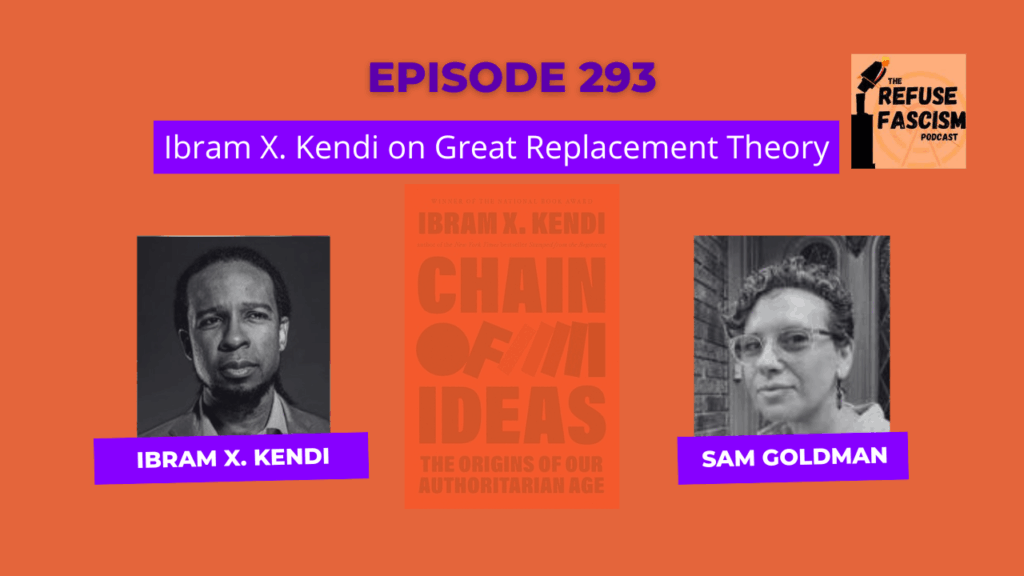
Episode 293
Sam speaks on the events of the week including the fascist coup fund, the theocratic extravaganza on the national mall, the neo-Nazi mass murder, new green card restrictions, and how to have hope in the face of all that.
Then, she speaks with acclaimed historian and author Dr. Ibram X. Kendi about his new book, Chain of Ideas: The Origins of Our Authoritarian Age.
Mentioned in this episode:
Bradley Onishi: This Is Christian Nationalism: Breaking Down Rededicate 250
Sasha Abramsky: We Should All Be Mad As Hell About Trump’s $1.8 Billion Slush Fund
Text REFUSE to 855-755-1314 or sign up online, follow @RefuseFascism on social media (@RefuseFashizm on TikTok) and our YouTube channel: @Refuse_Fascism.
Support:
- Subscribe to Refuse Fascism on Substack
- patreon.com/refusefascism
- donate.refusefascism.org
- Venmo: Refuse-Fascism
- Buy merch (Big Cartel)
- Buy merch (Fourth Wall)
Music for this episode: Penny the Snitch by Ikebe Shakedown
Refuse Fascism Episode 293
Ibram X. Kendi on Great Replacement Theory
May 24, 2026
Ibram X Kendi 0:00
I wrote this book because we’re all facing just an avalanche of highly sophisticated propaganda that separates us. I instead wanted people to have the lens to see that propaganda, so that they can begin to link up in the chain of humanity and recognize that chain. Once we recognize that human linkage, it allows us to begin to build political solidarity. The more allied we are, the better ability we have to take on the fascist oligarchs.
Sam Goldman 0:53
Welcome to episode 293 of the Refuse Fascism Podcast, a podcast brought to you by volunteers with Refuse Fascism. I’m Sam Goldman, one of those volunteers and host of a show. Refuse Fascism works to unite all who can be united in mass nonviolent resistance in the streets and throughout society to drive the Trump fascist regime from power.
This week, we’re sharing an interview with Ibram X Kendi, discussing his latest book, ‘Chain of Ideas: The Origins of Our Authoritarian Age’. Before we get to this week’s episode, a huge thank you to everyone who supports the Refuse Fascism Podcast, our patrons, our paid Substack subscribers, everyone who subscribes for free, everyone who shares episodes, leaves ratings and reviews. These really matter and help spread this analysis.
This show is part of building the understanding and collective resistance people urgently need right now, and none of it would exist without your support. So, if you value the show, subscribe, leave a rating or review, share this episode with friends, with your networks, and consider becoming a paid Substack subscriber, or a monthly supporter through our Patreon, or making a donation at RefuseFascism.org And, of course, another way to support is by getting Refuse Fascism merch. There’s Trump Must Go Now lawn signs, there’s Refuse Fascism hats, bandanas, and other summer-friendly gear that you can get via the show notes.
This week’s interview with Ibram X. Kendi gets deep into the chain of ideas undergirding great replacement theory, which makes up a large part of the ideological foundation of the Trump fascist regime’s agenda. This is the belief that global elites often read as “the Jews,” are using Black and brown immigrants to usurp and literally demographically replace white people. You’ll hear in the interview that this theory is not a mere rhetorical device, but it has very real and often deadly effects in the real world.
This week has given us no shortage of examples. This past Monday, two young men covered in Nazi symbols and racist slogans attacked the Islamic Center of San Diego, killing three beloved community members: Amin Abdullah, Mansour Kazia, and Nader Awad. According to reporting from KPBS, a manifesto, most likely written by the murderers, shows that “The pair believed in right-wing conspiracy theories about immigrants and Jewish people, and sought to replicate the 2019 Christchurch, New Zealand shooting, where 51 Muslims were killed at two mosques.”
These mass shootings give insight into one aspect of great replacement theory. At the same time, the scale of violence inspired by the theory now reaches millions across the globe through the power of the most lethal force the world has ever seen, the U.S. government’s economic, political, cultural, and military might. U.S. Citizen and Immigration Services, an agency within the Department of Homeland Security, issued a memo Friday saying that most green card applicants will have to apply from their home countries. This will affect hundreds of thousands of people, including spouses of U.S. citizens, anyone in the U.S. on a student visa or a work visa, as well as many humanitarian parolees, threatening them with ICE detention in Trump’s growing network of concentration camps.
This is not a minor adjustment. Green card applications usually take at least nine months, but more commonly years, and sometimes decades. At the same time, Trump is issuing demands to Congress to accept 10,000 more refugees from one peculiar country, South Africa. Since October, the U.S. has resettled over 6,000 white Afrikaners, compared to three from the rest of the world combined. That’s not 3,000, that’s three. Tens of thousands of people around the world have gone through years long refugee application processes, often living in squalid refugee camps and other dire conditions, with the hope of getting accepted by the U.S., to have their hopes dashed, in favor of the heirs of South African apartheid regime. Many had gotten to the final stages of the process, selling property, quitting jobs, before the entire process was all but shut down.
And this week, Trump is calling for 10,000 additional refugee applications to be accepted exclusively from white South Africans. The connection to great replacement theory is not subtle. Trump has openly claimed that the South African government is committing a white genocide — the foundational paranoia of much of today’s global fascist movement. This past week we also received the first comprehensive estimate of U.S. citizens, children ,separated from parents by Trump’s mass deportation campaign of ethnic cleansing.
The Brookings Institute is reporting that since Trump returned to office, approximately 100,000 families have been separated, with at least one parent detained by ICE. The fascist ideology of great replacement theory may be most widely associated with neo-Nazi academics and MAGA world talking heads like Tucker Carlson, but its impact is far-reaching and extremely deadly. Hopefully, through this interview, you can learn not only to recognize its influence all around us, but take it on and help defeat it politically, most directly by driving the theory’s most dangerous adherents, the Trump fascist regime, from power. Now, we have to get to one of the most talked about developments from this past week.
Trump, alongside his Trumpified DOJ and Treasury Department, settled his outrageous $10 billion lawsuit against the IRS by effectively granting himself and his family immunity from potential tax fraud investigations, while creating a $1.776 billion slush fund to hand out money to January 6th insurrectionists and others claiming to be victims of the so-called weaponization of the Justice Department.
It’s worth emphasizing, as Sasha Abramsky for The Nation pointed out, “Unlike the men, women, and children who have simply been disappeared into makeshift concentration camps by Trump’s regime, those “victims” actually received jury trials, were found guilty by their peers, and were sentenced not for being Trump fans, but for battering Capitol police officers, for hunting congressional members with the intent of killing them, for vandalizing the citadel of American democracy, and for trying to subvert the will of the people by preventing the peaceful transfer of power.”
This is what some have called the most brazen act of presidential corruption this century. This is fascist gangsterism consolidating itself in broad daylight. Trump is effectively turning the Department of Justice into his personal slush fund, funneling money and protection toward the very forces that carried out violence on his behalf on January 6th. This is a president using the power of the state to reward loyalists, punish enemies, and strengthen a movement already organized around violence, intimidation, and revenge. And the deeper danger is not simply the corruption itself, it’s the confidence with which Trump acts, the confidence of someone who increasingly believes every institution has either been bent to his will or proven unwilling to stop him. In effect, Trump is being treated as above the law, both publicly and privately.
Meanwhile, much of official politics responds by reducing all of this to just another scandal to be litigated in the next election cycle, once again insisting people should simply wait for the midterms while fascism advances itself in real time. The matters for which Nixon was driven from office increasingly look minor compared to what is unfolding now. What’s being adjusted to is a regime openly transforming the machinery of government into an instrument of fascist rule, rewarding political violence, purging opposition, prepaying its own private army, and consolidating rule through fear, loyalty, and impunity.
There’s a temptation when Trump’s poll numbers drop to think the danger is fading, but fascist movements don’t necessarily become less dangerous when they lose popularity. Often, they become more dangerous. Trump’s approval rating has plunged into the 30s, and one of the most chilling things about this moment is that he increasingly seems not to give a fuck. Typically, this would result in the politician recalibrating, broadening appeal, trying to stabilize support. But instead, Trump, being Trump, being a fascist, survives through escalation. Which, I want to clarify, doesn’t mean that they never respond to opposition or take a tactical retreat. They do, they have, but more often than not, and strategically speaking, they respond by doubling, tripling down, acting like a cornered rat, or right now acting like they’re on a revenge campaign directed against fellow Republicans who cross Trump.”
Folks need to grapple seriously with what that means, because this should fuel the demand that Trump Must Go Now! This regime must be removed immediately. The more Trump goes down in the polls, while showing brazen indifference to mass public opinion, the more it reveals the nature of what we are confronting: a fascist regime through and through. It reveals a movement that increasingly believes it does not need broad democratic legitimacy; that it can consolidate power through intimidation, institutional capture, suppression of opposition, and the demobilization of the public.
Now, putting his madness and delusions aside, we see something much deeper than that. The Trump phenomena has operated as an ongoing rolling fascist coup for years now — testing limits, shattering norms, transforming the courts, purging opposition, and conditioning people to adapt to open terror, step by step. That’s why falling poll numbers create both possibility and danger. In terms of possibility for the removal of this regime, it does crack the aura of inevitability of this fascism. The polls also may widen splits among those in power. It may create openings for millions more people to step into political life and refuse accommodation.
But in terms of danger, because fascist movements often become more volatile and aggressive when legitimacy slips, we can count on likely repression. We can assume a harder lashing out. Patterns, and evidence says that they’ll move faster to lock in power, while opposition remains fragmented and passive. Which is why poll numbers alone mean nothing if millions remain spectators. The critical question is whether people act collectively and visibly in ways that project the demand that millions feel in their hearts, as evidenced in these poll numbers, but as yet to be manifest — Trump Must Go Now! — and to do so in ways that change the whole political calculus.
It didn’t make it into last week’s recorded episode, so I do want to just spend a moment. I mentioned it briefly in the interview itself, but I do want to mention briefly last Sunday’s Rededicate 250 National Prayer event, White House-backed religious gathering that was held to mark the exact 250th anniversary of the Continental Congress’s 1776 day of fasting and prayer. I highly recommend listeners go and check out Bradley Onishi’s coverage on the day, which covers the actual history of that 1776 day of fasting and prayer, along with what this all means, and we link to it in the show notes.
What struck me in what I watched from Rededicate 250 wasn’t just the content, though we’re going to get into some of the content, it was the surreal spectacle of it all — that thousands gathered on the National Mall for what was essentially a state-sponsored Christian Fascist Revival meeting, complete with leading politicians, even though that most joined via video, corporate backers, giant glowing crosses, and merch tables selling pins that read things like “Wives submit, children obey.” Because if there’s one thing America knows how to do, it’s monetize the rise of theocracy. Much of the mainstream response was: Wait, taxpayer dollars paid for this? That was the scandal, not the theocratic fever dream unfolding in plain sight. The problem was the invoice.
This was like the opening ceremony for the soft launch of theocracy of the very American variety. Which is maybe why I’ve had trouble watching the boys lately, not because of the grotesque, comical violence of the show — it reflects the reality of this violent American empire — but because satire stops being satire when reality starts doing self-parody better than television. At a certain point when DHS is literally declaring itself one homeland under God, and you have a giant white cross towering over the National Mall, while speakers praise glorifying the name of Jesus over our nation’s capital, the writers of dystopian TV are probably sitting around the writers room, going: Well, damn, that’s a little on the nose.
The thing is, this wasn’t just generic religiosity, this wasn’t people expressing faith, this was a very specific political theology — Christian nationalism, Christian fascism, One Nation under God, but only under their God, a white evangelical nationalist God — not Muslims, not Jews, not Hindus, not atheists, not queer people, not black people demanding their humanity, not Black and brown immigrants, not native people, not even Christians who don’t subscribe to the MAGA apocalypse package. Speaker of the House, Mike Johnson, stood there talking about God’s hand being on America, “Since Christopher Columbus set sail for the new world.” Which is a hell of a sentence when you know what actually followed Columbus, you know, the genocide, conquest, slavery, doctrine of discovery.
That doctrine literally declared Christians had the right to occupy and dominate lands inhabited by non-Christians, because those people supposedly did not possess legitimate claim to the land. What they’re doing now is trying to repackage that history as sacred, to transform conquest into destiny, slavery into an unfortunate footnote, resistance into disobedience. They are constructing a myth of a divinely ordained nation, whose crimes must either be denied, sanitized, or sanctified. A nation who, despite all evidence to the contrary, has always been a Christian nation. It’s important to understand that this isn’t hypocrisy, it’s coherent. The same worldview demanding wives submit at home is the worldview threatening entire nations abroad. The same ideology declaring America chosen by God is the ideology justifying domination over anyone outside that divine order.
So, while speakers called for biblical submission and Christian authority over public life, Trump was online, I think, later that day, threatening Iran like a mob boss with nuclear weapons. “The clock is ticking,” he warned, via Truth Social, implying an entire nation could be obliterated if it didn’t comply fast enough. That isn’t some contradiction, that is the world view: submission for women, submission for dissenters, submission for bBack and brown immigrants, submission for other nations, a social order built on domination, sanctified by God, and enforced through state power. Christian fascism at home and imperial domination abroad are not separate projects, they reinforce each other.
As Bradley Onishi put it so well, “Christian nationalism is not about loving God and loving your country, it’s about believing you deserve more of the country because of your God.” That’s the project here, and what chilled me the most wasn’t the brazenness of the event, fascists have always wrapped brutality in righteousness, what chilled me was how little coverage there was of this that was sounding the alarm…like how quick this has all just become accepted. The museum-like coverage of it all, like National Geographic reporters observing some fascinating remote tribe. [announcer voice] Here we see the Christian nationalists in its natural habitat, clutching a shofar and a Chick-fil-A lemonade.
No, these are not curious artifacts seeking to erase separation of church and state, seeking to define who counts as a real American, seeking to make everyone else at best second-class citizens. This is what is in power in this country, and while the crowd size matters — it’s a really good thing that there weren’t tens of thousands — that’s besides the point. We should say plainly what this event means. If the government officially defines America as a Christian nation, then anyone outside their approved version of Christianity becomes fundamentally suspect; outside belonging, outside legitimacy.
That is the logic of fascism, always: a mythic past, a chosen people, a strong man presented as divinely appointed, submission framed as virtue, enemies as internal contaminants. Listen to how Franklin Graham talked about transgender folks, and you know, members of the LGBTQ community. And underneath it all, of hierarchy enforced through fear and brute force, methodical exclusion through violence. This is not some future danger we’re being warned about. This is the regime showing us exactly what it’s building, now. But they are not all powerful, and they are not the majority. There are tens of millions of people in this country who do not want to live in a society organized around cruelty, enforced ignorance, patriarchy, white supremacy, xenophobia, and blind obedience disguised as morality.
The question is whether those millions can be brought together? Not isolated, doomscrolling, accommodating themselves to horror or waiting for salvation from the next election, but finding their power in each other and acting together with courage and determination, now. The question is whether we act like the emergency this actually is, with millions in the streets refusing business as usual, when that business as usual means cementing fascist rule. It means many voices and bodies together demanding the Trump Fascist Regime Must Go Now! creating a political crisis from below so profound that this regime cannot smoothly govern, cannot fully consolidate their rule, cannot carry forward its program uncontested, cannot even maintain the reins of power, and fighting for something radically different. A world where no human being is deemed illegal, disposable, or born for a life of submission. A world where truth and science matter. A world where both the people and the planet can heal.
Lately, I’ve been thinking about that there’s a kind of politics and a kind of online culture that mistakes hopelessness for seriousness, as though the more cynical you are, the more intellectually honest you must be — as though scoffing at people, expecting the worst from everyone, and insisting nothing can fundamentally change, nothing will ever, could ever get better, is somehow a sign of sophistication. I’ve just gotta say, that’s not serious. It’s easy, it’s superficial, it’s bullshit. We have to be serious enough to look beneath the surface. Doing that is the first step to seeing what possibilities do actually exist and what is needed from us to make them real.
Most people need some basis for hope to persist, to take risks, to stand up when standing up carries such consequences. I’m not talking about fantasy or delusion or pretending everything will magically work out, but confidence that human beings can act on the world and change it together for the better, even for the most emancipating and liberating ways, people need to believe that collective action matters, that other people are worth it. Isolation and hopelessness serve the fascists we’re up against just fine. It helps them when folks stop imagining themselves as part of a collective force larger than their individual survival. It helps them when politics becomes reduced to private despair, punctuated by periods of scrolling and occasional outrage.
Our best chance for victory is finding hope in each other, in what we build and what we create together, in the collective response we carry out, in learning to unite and not divide, in coming back stronger in the face of repression. Our best chance of victory is made increasingly more possible when we imagine together and strategize together on what it will take to not just individually survive this nightmare, but to politically defeat it — especially now when so much of this culture trains people to become spectators, to collapse, to confuse bearing witness with taking action, to consume politics as content instead of engaging it as something that demands our participation, our sacrifice, our courage, our community. We need each other. We need organized communities of resistance and care capable of acting together under rapidly changing, and yes, rapidly more repressive conditions.
Part of what makes fascism so dangerous is precisely that it tries to destroy people’s faith in humanity, our faith in one another, by teaching fear, suspicion, scapegoating, cancelation — reveling in isolating people from their own power. But again, there are tens of millions of people who do not want this future, tens of millions sickened by the cruelty, the degradation, the lies, the bigotry. Tens of millions who have not yet fully accommodated and adjusted to a fascist America. The challenge that we have together is whether those people can find each other, trust each other enough to act together, and discover their power before this regime consolidates — something even more terrible.
While victory is a certainty I can’t provide, what we can do is we can each make our refusal to accept a fascist America in the name of humanity a lived act, spreading the demand Trump Must Go Now! and making it a real force in the world — learning more about why this demand is profoundly necessary, and is possible to be realized, and knowing that this is how history moves. Thanks for joining me on that road. With that, here is my conversation with Dr. Ibram X. Kendi.
The Trump fascist movement has repeatedly weaponized great replacement theories to convince the MAGA base that they are being deliberately subjugated, politically, culturally, by brown immigrants, Black people, women, trans folks. For Trump, this goes back to at least the birther lie he pushed against Barack Obama in 2008 when he sought to delegitimize the country’s first Black president by demanding proof he was really American. Today, in Trump’s second term those politics have escalated, calcified, become codified, an all-out assault on immigrants, a program of ethnic cleansing through mass deportation, the all-out assault on Black voting power, attacks on DEI, attacks on anti-racism, the targeting of so-called anti-Christian bias, and the branding of any dissent — anti-fascism itself — as threats to the nation, a wholesale effort to define millions of people as threats to the real nation.
So how do we understand how great replacement theory seemingly went from the fringes to dominant and dominating political thought, and how understanding these chains of ideas globally helps us in breaking them. To do that, I am so honored to be speaking with acclaimed historian and author Ibram Kendi, whose latest book, ‘Chain of Ideas,’ traces the global rise and evolution of Nazi and neo-Nazi great replacement ideology, and how it became the driving ideological force ushering all of humanity into this authoritarian age. Thank you so much for joining us, Dr. Kendi.
Ibram X Kendi 25:18
Of course, thank you for having me on.
Sam Goldman 25:20
One thing that your book makes very clear is that great replacement theory is a kind of connective tissue that links together a whole range of talking points, fears, hatreds that define reactionary politics globally. We used to see it on the fringes, and now it’s dominating the whole globe. Let’s start with: Can you explain what great replacement theory is at its core, and why it became, as you argue, the most dominant political theory globally, especially here in what I consider the most lethal superpower the world has ever known.
Ibram X Kendi 25:59
I thought it was important, first, to map and understand the complete history of great replacement theory, and certainly ‘Chain of Ideas’ chronicles its resurgence over the last two decades, but it’s a theory that traces all the way back to those who are defending colonization, obviously to Mussolini, to Hitler, to a whole host of eugenicists, to apartheid officials. But once I ended up sort of mapping and understanding its complete history, and particularly its manifestation globally today, I ended up defining it as a political theory that suggests that there are these globalist elites who are enabling peoples of color to displace the lives and livelihoods, even the cultures, even the electoral power of white people, who thereby need authoritarian protection.
When we think of that definition, it has four major component parts that have to be understood. So first, the part of that there are these globalist elites. Those who are articulating great replacement theory are almost always positioning their political opposition, and it doesn’t actually matter where they are in the ideological sort of scale, it could be someone who’s center right, center left, so-called far left, but their political opposition as enabling the great replacement, and that their political opposition is all powerful. Similarly, how Nazis framed international Jewry as all powerful.
Then obviously the idea that there are these replacers who are typically Black people, brown people, Muslims, and that white people, so-called white natives, who are imagined to be native to every country where they exist on earth, including the United States, South Africa, New Zealand, Israel, you name the country, and then finally that because these people are being displaced and replaced violently, if not nonviolently, they need protection, and they need strong protection. They need authoritarian protection. So these authoritarians say, in order for me to protect you, I have to do away with your civil liberties and have to erode democracy. It becomes a justification…it becomes a way for authoritarians to get people to consent to their own domination.
Sam Goldman 28:25
I found that a really helpful framework, and thinking about the framework of self-defense, as the constant through line of doing the most heinous acts, either because they’re already being done to you, or they will be done, like the preemptive self-defense. When I was reading your book, one thing that struck me was that you make the point — I think you use a parent analogy or something like that — that ideas can exist long before they’re formally named.
You point out that Camus gave the theory its modern label in 2011, but the underlying logic goes back much further, especially into colonialism, tracing the origins of replacement theory back to colonial officials in the late 19th century; people that imagined that if colonized people ever freed themselves, they would eventually replace Europeans and do to Europe what Europe had done to them. I’m wondering: What does that origin story, or what should that origin story, reveal to us about the thought process and function of great replacement theory.
Ibram X Kendi 29:33
First and foremost, that origin story of great replacement theory during the era of colonialism, maps directly on to Renaud Camus, who coined the term great replacement with his book in 2011 arguing that another way that people can understand, he argues, the great replacement is settler colonialism. He argues that in the case of France and Europe more broadly, they are facing settler colonialism at the hands of African people who are primarily Muslim. He describes them as invaders and occupiers.
He argues that Africa’s colonization of Europe is worse than Europe’s colonization of Africa, and then obviously he argues, because he says that it is leading to more demographic changes than Europe’s colonization of Africa. Which I actually pointed out in ‘Chain of Ideas’, I don’t think people recognize the relationship between European colonization of Africa and the transatlantic human trade — one had to precede the other.
So when we think of the transatlantic human trade, one estimate finds that the number of African people who were taken, frankly, from the land, is equivalent to the entire size of France today. So you talk about sort of demographic change… But in terms of your question, I think one thing that it reveals is what I call the first link in the chain of ideas, and that is this zero-sum story. The zero sum story, with the logic of a colonial official, would say that Europe, right now, is colonizing Africa. If African people seek decolonization, they’re not going to just seek their own liberation and their own sovereignty. Someone who is infested with zero sum logic is going to say: No, they’re going to come and try to colonize us. Because the idea of having a world where we are all collectively sovereign, liberated, and free is beyond the conception of someone with zero-sum theory. Either you’re dominating me or I’m dominating you. And so that to me derives all the way back from those colonial officials.
Sam Goldman 31:54
Speaking of these links that you put in your book, there’s ten of these links, and my understanding from reading it is that they form these building blocks for what is now modern great replacement theory. For listeners who are trying to understand what’s driving this ideology right now in the United States: Is there one of those links that you think is the most dominant or most dangerous in the moment? My husband and I were discussing them as, like, well, which is the most prevalent isn’t always the most dangerous, and which is the most dangerous might not be the most dominant. So I think it’s probably most helpful to think of: What is shaping things the most, and out of that, what is most dangerous, perhaps?
Ibram X Kendi 32:43
The link — so there are indeed ten links in the chain of ideas — the link that is most shaping our moment, and frankly, is the most dangerous link, is the final link in the chain of ideas. This is the link that, once someone believes this idea, they are captured. All of the links, all of the ideas, lead up to this one. It is trying to get people to fight for privileges provided by dictators instead of power provided by democracy. I think it’s self-evident why that is so dangerous. That’s what makes great replacement theory so vicious in this moment, because we’ve talked for a long time about how you have certain groups who are acting against their own “self-interest,” particularly their economic self-interest.
This is way beyond that. This is trying to get people to clamor for dictatorships, to feel that a racist dictatorship is better for them than, let’s say, an anti-racist democracy, for them to feel as if the only way in which they will be able to survive or thrive is through someone like a Trump — even as the track record is that they are struggling as a result of the policies and the predation of a someone like Trump. That’s what makes this so vicious, and so I tried to document, particularly in that section, how you have a growing number of people around the world, particularly younger people, who are stating that they would prefer a dictatorship over a democracy.
Just as you have people in the United States who the majority of Republicans actually supported Trump when he said he wanted to be a dictator for a day. There are Republicans who said: You know what, sometimes (and I’m quoting one directly that I cite in the book) sometimes a country needs a little…a good paddling. These are the types of things that people are saying, meaning that they’re literally coveting a dictatorship, and they think that a dictatorship is gonna free them.
Sam Goldman 34:56
It is so disturbing, and also, so clarifying, when you’re able to see the stakes and the idea that undergirds it. That that’s part of what I’ve appreciated a lot in the book, and in a lot of the conversations that you’ve had about the book. I’m saying this early for people that are like: Wow, you’re really going there again and again — but I’m saying it early, so that people have this seed in there, The more that we…that you make this point consistently, is that the more that we understand what it is we’re confronting, the better we can go to work on it.
As you were speaking, I was thinking about — I think it was to CPAC — Trump had said: “Vote for me and you’ll never have to vote again,” and that that was met with applause. That is the example of what you’re talking about, people thinking that that is a form of protection. You make this intervention in your book that maps the historical conditions that allow the proliferation and mainstreaming of great replacement theory — and I want to emphasize for listeners, Dr. Kendi does this with many, many global examples. It is not the U.S. as the center of everything; it’s about what’s happening around the world.
What struck me in your argument was that you write economic crises create openings where people experiencing instability, loss, humiliation, become vulnerable to narratives that direct their blame towards oppressed people instead of upward towards the oppressor. They look at a symptom of the system and diagnose it as the source. Like the refugee crisis caused by global warming, and they identify the crisis as refugees coming, not people losing their homeland. One of the focuses is the financial crisis, and helping these politics take off, because people are losing their jobs, they’re losing their homes, they’re losing their social status, and they’re told that who is responsible is immigrants, in particular brown immigrants, Black folks, Muslims — I think those were the main groups at the time.
I’m wondering if you could talk more about why are these periods of economic crisis so fertile for this form of politics, and given that we are now under Trump, under a great replacement advocate, I guess, is the way to put it, people are facing hardships. Do you see even more of that now? Is this a fertile ground?
Ibram X Kendi 37:30
I try to really provide a nuanced research-based description of the relationship between economic crises and racist ideas, and how a Trump or an Orban or a Putin, or a Bolsonaro in Brazil, or Farage in the U.K., or Modi in India could use a situation in which there’s an economic crisis to advance great replacement theory, and therefore advance their own political standing in the country. Let me give an example of how this works. This is an example that I think many people can understand. Most people who live in cities, particularly major cities, are recognizing that there is particularly affordable housing crisis. There’s just not enough affordable housing for us.
So then the question becomes: Why? What these great replacement politicians do is they give an explanation for this complicated phenomenon that both covers up their role in the shortage of affordable housing, and simultaneously causes people who are resentful because they don’t have housing, or better housing, to blame a particular group. For instance: There isn’t affordable housing because there’s so many immigrants. It’s an easy idea that there’s more people, there’s apparently going to be less housing for us all. But if you let’s say are a politician who has long provided support for developers to create these luxury apartments that are 3,000 square feet or 4,000 square feet, that are $5 million, that actually are the reason why there isn’t affordable housing — it’s taken up so much real estate, and it’s so expensive — you’re not going to want people to blame those developers or you.
Instead, you’re going to want them to blame “immigrants.” I think that’s the way this is happening. People already despise, or already don’t know, already believe that these strangers are dangerous, so that’s how their ideas about, let’s say, Black or brown immigrants — in which they already view them as a problem — gets chained into saying they’re actually not just a problem in the abstract; this specific problem you have right now, they’re the cause,
Sam Goldman 40:02
We’re seeing that more and more,, and this is something that isn’t just happening in modern U.S., but this has been a trend before. We’ve seen the echoes. That was an important highlight of the book for me. Another thing that I think is worth talking about when talking about great replacement theory is that it’s not a rhetorical device. There’s a lot of substance in the text about: some of them are grifters, some of them are using this, some of them, you’re not going to know what they actually think. To a certain extent it doesn’t matter — this is what they’re saying, this is what they’re doing.
But these are lived acts — lived acts of terror by… You go into detail of several instances in the US and around the globe of acts of violence by great replacement adherents like the Tree of Life, El Paso, the Buffalo massacre, and what we can assume, probably, was behind yesterday’s attack at the Islamic Center in San Diego. So there’s those massacres that this is behind, where you see explicit replacement rhetoric in their manifestos, and you see it in policy — that is, in the policy of whether you look at the mass deportation agenda of Trump, or in the policy of white grievance reparations coming from the settlement with the IRS. But why is terror the logical conclusion of this theory?
Ibram X Kendi 41:34
I’m happy you asked that question, because I think this is precisely how and why I ended up arguing that great replacement theory is the world’s most dangerous idea. Because the most extreme form of great replacement theory is what I call in the book, genocide theory. It is this notion that the replacers are not just coming to take your jobs or to take your housing, or to take your culture, or to take your nation, that they’re literally, according to these theorists, engaging in a genocide of white people — engaging in a genocide of men, or Christians, or whatever privileged group.
Once you believe that your group is dying, your group is facing a genocide, then it leads some people to then want to go and pick up their guns and literally engage in political violence against the group that’s imagined to be engaging in that genocide. That’s why, for instance, the shooter who engaged in the mass shooting at the Tree of Life Synagogue in Pittsburgh, he imagined that Jews were enabling immigrants to come and replace “My people,” and so he said: I can’t continue to allow my people to get slaughtered, so I’m going in. Dylan Roof, who murdered Black people in a church in South Carolina believed that, “Black on white crime…” and he had been reading this website, in which it listed all these imagined Black on white crimes, that that signaled a genocide.
So he needed to protect his people. Each and every one of these people believed that there was a war going on, and that they needed to take up their arms and become a soldier to defend their people. So that is sort of political violence, but then great replacement theory can also justify genocide in the name of protecting against the genocide. I write about the rhetoric that Putin used to invade Ukraine. He argued that Russian speakers in Ukraine were facing a genocide, so they needed to literally come in and protect them, and he completely made that up.
Similarly, that’s precisely how Hitler justified almost every invasion that he engaged in before, and certainly after World War Two started — that he was protecting Germans who were facing a genocide. You can talk about individual violence, but even state violence, great replacement theory can be used to justify and defend state violence. And finally, I’ll mention that you have people within the Trump administration, who imagine that there’s this clash of civilizations between Christianity, or what they’ll call the Judeo-Christian — which, for anyone who knows anything about Jewish history, to sort of conflate Jews and Christians as if they’ve been allies all this time — this Judeo-Christian civilization versus Islamic civilization, and that Iran is at the sort of head of the snake, and that this Islamic civilization is trying to take over and destroy Judeo-Christian civilization, so we need to apparently defend the civilization from these invaders and replacers. That’s one of the ways the war against Iran by the United States and Israel was defended.
Sam Goldman 45:02
Really important. I couldn’t help at the end of your remarks just now thinking about the Rededicate 250, nine hour long Christian nationalist festival. I don’t know if you had the privilege of watching any of it, but having just read your book, so much of it was like: Oh, there’s a link about that in here. You had Hegseth, of course, talking about American Crusade, Johnson talking about, like, returning to the Christian roots, I think, and Rubio…I think Rubio’s might have been the worst in terms of the Western civilization pro-genocide video that he provided. I don’t know if there’s any thoughts that you have on that link.
Ibram X Kendi 45:49
Yeah, the sixth link in the chain of ideas, and this is a pretty crucial one, is the idea that white Christians are indigenous to the nation. This link is absolutely pivotal to great replacement theory, because great replacement theorists primarily are positioning peoples of color, and especially Muslims, as the replacers. So the only way in which you can do that is, in the U.S. context, in particular, is to say that white people and Christians are indigenous. Now, even in the European context, I wrote extensively, about even arguing that white Christians are indigenous to Europe is an ahistorical idea.
The reason why that’s ahistorical is for the better part of European history, people were not identifying as white or Christian. Islam arrived not long after Christianity did, in Europe. Of course we have traces of people who are now identified as people of color dating all the way back to antiquity, but to say that white Christians are indigenous is to literally erase the better part of European history where people did not worship Christianity, where people did not identify as white.
I think, interesting, I should also add that, as I was writing this book, I was watching a few shows on Netflix…it just so happened that I was watching a few of these shows on Netflix that depict Europeans who were practicing pre-Christian religions, facing these Christian invaders who are trying to wipe them out. These shows like “Barbarians” and others, whether it’s these Germanic tribes or the Vikings or others, part of the challenge, and I write about this extensively in ‘Chain of Ideas,’ is one of the reasons why these ideas work on white people, is, for the most part, white people don’t really know their own history. That’s part of the challenge.
Sam Goldman 47:53
I feel like that really, really resonates. I’ve been thinking a lot about 250 years and this celebration. I’m sure you’ve seen it. It’s been viral, the plate that was sold at Walmart, that has, like, the end point of 2026. So you’ll have a lot of people that, in my opinion, you know, believe in America and are mourning what they see as the loss of America, the loss of American democracy under Trump. Then you have, on the other hand, Trump and the whole regime, and everybody celebrating this, this new thing that they’ve created, that is, in my opinion, a lot like the old thing.
When you were talking about people not knowing their history, I felt like that is so, so true, white people not knowing their own history, and people generally not knowing history, period, and the impact or difference that makes. I know that knowing history doesn’t inoculate one from great replacement theory, but what do you think that, like, having a true understanding of this country’s history, even… what difference that makes in, you know, again, it’s not going to stop these ideas necessarily? Or maybe you don’t think that.
Ibram X Kendi 49:16
Well, let me give you an example, because we were just talking about the 250. I think many non-Black Americans would understand how Black Americans, when we think of 1776, most Black Americans know that the majority of Black people at that time in the British colonies were enslaved. So for this president to say to Black people who were not represented at the Second Continental Congress, who in many ways were not even included in constructs of “all men,” for us to essentially connect ourselves to those so-called founding fathers, I think most Americans would say: Okay, that makes sense.
But what many white Americans may not realize is for whatever reason identify with those wealthy white male enslavers and non enslavers, even as to identify with those wealthy white male enslavers who signed the Declaration of Independence is equivalent to saying: I am like Elon Musk today; or: I am like another billionaire today, and I’m connected to them. Most white Americans do not necessarily connect themselves to those billionaires, but when they, but when they think historically, they do. I’m saying that to say, in 1776 the vast majority of white people were either indentured servants who were impoverished, were subjugated were landless, and so the poverty and the levels of poverty and subjugation then was astronomical.
So even as you have people who are like: Okay, I can understand why Black folks, when they think of 1776 they’re like: I don’t know about that. But to me the vast majority of white folks should do that too. Even, you had John Adams’ wife, who wrote to John Adams when he was there, and was like: Remember the ladies — and he laughed at her, I’m not thinking of you. It’s all there in print, it’s all there in evidence that this was wealthy white racist, largely enslaving men declaring independence from British colonizers for their own personal benefit.
Sam Goldman 51:27
I feel like we have to talk about, in that spirit, some recent developments. One of them is the attacks on Black voting power, Black political power more broadly, after the gutting of the Voting Rights Act and the post-Callais redistricting frenzy. How do you see that as part of the same lineage of great replacement panic?
Ibram X Kendi 51:53
One of the key constructs that I explore in Chain of Ideas is what I call the inversion of anti-racism. This links up conceptually with the inversion of feminism, the inversion of LGBTQ activism, the inversion of anti-Zionism. The way that it operates is that, and I think it’s long operated, feminism has long been inverted as anti-male, but it’s operating similarly, in which anti-racism is being inverted as being anti-white. So it’s not about creating equity and inequality and justice for all. It’s being inverted to claim that it’s actually harming white people, just as feminism is being framed as harming men, just as LGBTQ activists are being framed as “grooming” and thereby harming children.
The reason why this becomes pivotal is because this becomes the ideological atmosphere in which the Supreme Court can claim that a voting rights act is harmful to the nation — that the clause that the court pretty much gutted that ensured the representation of Black people in Congress was actually harming white people. This nucleus idea within great replacement theory… So there are the ten links we talked about, the fifth link, the central link, is the idea that anti-white racism is on the rise, and that idea is predicated on the notion that equity efforts, anti-racist efforts, efforts to create congressional representation for all groups is actually, they argue, anti-white and anti-white racism in harming white people. This is not necessarily surprising to me.
I should also add link three, I write about how these great replacement theorists have redefined racism as biological prejudice and interpersonal discrimination. What’s also pivotal in their redefinition is they focus on intent as opposed to outcome, which is of course how the Supreme Court justified its ruling. So all of the logics that has been circulating around the world via great replacement theory was wrapped up in that Supreme Court decision and the subsequent erosion of these majority black districts, which, of course, are being framed as racial or racist, and all the majority white districts that are being created in their stead are being framed as race-neutral.
Sam Goldman 54:29
Really helpful breakdown. I was struck when I was reading — I was trying to pull up exactly where it was again, but — you had written about the overturning the Civil Rights Act in 1875 and what Supreme Court Joseph — Justice, I’m not gonna call him a Justice — Joseph Bradley wrote that racism had ebbed and black people could now “Be protected in the ordinary modes by which other men’s rights are protected.” that could have been written yesterday, and that that is horrifying. That is so horrifying.
There were several parts where I was like: Wait, did I read this date correctly? Is that, is that where, where they’re talking about? And for me, I feel like it’s connected to this panic over multiracial democracy itself. that’s kind of where we started in the beginning of the conversation. I’m wondering if you could break down a little bit, like why is multiracial democracy such a threat for them? ‘Them,’ to be clear to listeners, because I was a sloppy talker there, the ‘them’ is the adherents of great replacement theory.
Ibram X Kendi 55:37
Sure. In the book I write about what I call the great replacement political equation. This is the worldview that these theorists try to get white people to believe. They want white people to believe that the more Black citizens, there will be more Black power, and that Black power will only inevitably lead to Black supremacy, and that Black supremacy will then lead to white subjection, and that white subjection would lead to white genocide. So, for them, they’re trying to get white people to believe that the more power Black people have, the more they’re going to use that power to harm white people.
So, in order to protect you and your family and your livelihoods, you have to be anti-democratic. You have to oppose multiracial democracy, particularly as it relates to Black people. What’s striking about this, again, going back to our conversation about people not knowing their history, is that so many policies that white people have benefited from were actually put forth by Black politicians. That’s the irony. I wrote about in the case during the Reconstruction era, where you had Black politicians, many of whom were formerly enslaved, who were elected to state legislatures in the South, and they did things like create free public schooling that benefited the vast majority of white southerners.
They created all these public initiatives that benefited the vast majority of white southerners, just as you have white people now who are thinking about their livelihood under Obama versus under Trump, and it was better under the Black president. But for many people, for many great replacement theorists, they’re arguing that that’s an impossibility — that if there’s a Black person in a position of power, if Black people are in political office, their job apparently is to harm white people, when in actuality, the history and the evidence states that white people generally fare better under Black politicians relative to white politicians like Trump,
Sam Goldman 57:50
There’s a lot in learning from Reconstruction and the period after Reconstruction, a lot to learn in your book. Just getting at the notion of the expansion of citizenship and political participation framed as, or understood as, the dispossession of a civilization. The more that we can understand that, the more we can see through beneath the surface of a lot of…yes, very acutely and aggressively, their anti-Black policy across the board, and their anti-immigrant policy.
How is it that you can be accepting all these white Afrikanner descendants and then saying at the same time there’s a refugee crisis and you can’t accept any brown immigrants? People see that as something that’s hypocritical instead of something that is in this internal logic, consistent. As we close out the conversation, I want to end with how you end the book. Towards the end of the book, you write: “Either humanity will create conditions that confine people to the chain of ideas, or humanity will create conditions that link people to the chain of humanity.” How, right now, do we strengthen that chain of humanity?
Ibram X Kendi 58:36
I wrote this book because we’re all facing just an avalanche of highly sophisticated propaganda that separates us. I instead wanted people to have the lens to see that propaganda, so that they can begin to link up in the chain of humanity and recognize that chain. I tried to show the ways in which that we even in our sort of phenotypic and ethnic and cultural differences, were pretty much the same. There’s so many different cultures that eat rice differently, but they all eat rice. Different cultures and ethnic groups dance differently, but they’re all dancing. So, we’re all fundamentally linked, even in areas in which we think we’re separate.
Once we recognize that human linkage, it allows us to begin to build political solidarity so that we can understand, as history tells us, that as that group gains, I gain — as that group becomes more powerful, my group becomes more powerful. The reason being is because the more allied we are, the better ability we have to take on the fascist oligarchs. They thrive on our division, and they want us believing that we are political enemies, so that we are focused on each other as opposed to the real threat.
Sam Goldman 1:00:36
I want to thank you so much for joining us. I want to thank you, so much, more importantly, for your book, for sharing ‘Chain of Ideas’ with the world right now. That the book isn’t just a history of dangerous ideas, but the consequences and catastrophe that we’re headed into if these ideas continue to harden into governing power. I just want to thank you for your work, your time, and your voice, and people should go get the book. We’ll link it in the show notes. Is there anything else that you want to direct people to?
Ibram X Kendi 1:01:12
Well, no, I just want to thank you for the conversation. I’m excited for people to read ‘Chain of Ideas’.
Sam Goldman 1:01:18
Thanks for listening to Refuse Fascism. If you value this show, help us expand its reach. How do I do that? Well, you become a patron at Patreon.com/RefuseFascism, or you become a paid subscriber on Substack, or you make a one-time donation via RefuseFascism.org, just hitting that donate button, or you pick up merch to support this movement. There are many, many important ways to help, that cost nothing.
Share this episode with friends, with family, with your networks. Rate and review the podcast on Apple Podcasts, or wherever you listen. Subscribe to our Substack for free, recommend it to others, and stay connected and get involved at RefuseFascism.org and of course, follow us on the socials, @RefuseFascism. You can also text ‘Refuse’ to 855-755-1314 to join in. Special thanks to Richard Marini, Lina Thorne, and Mark Tinkleman for helping produce this episode. Until next time, In the Name of Humanity, We Refuse to Accept a Fascist America!