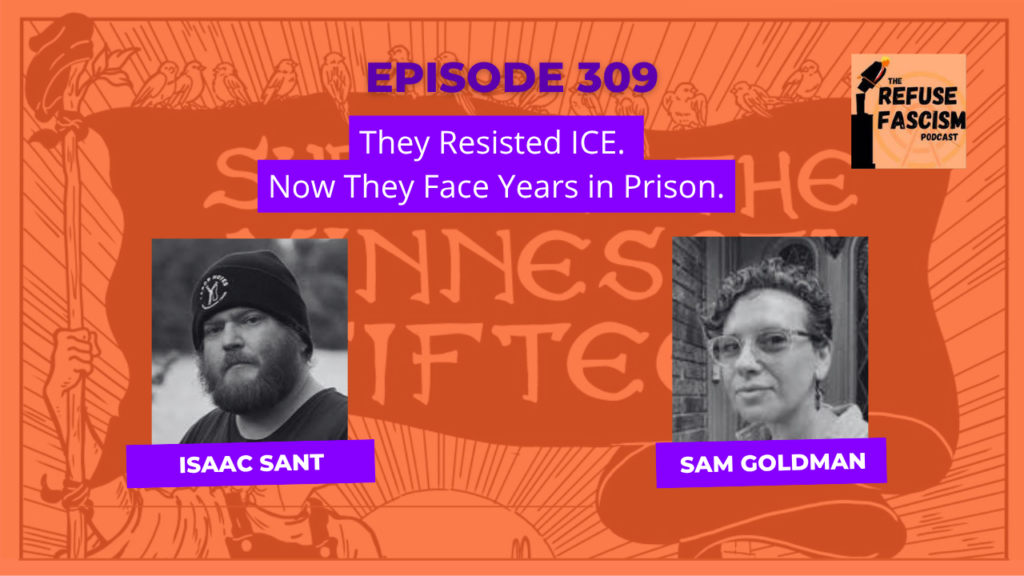
In the early months of 2026, thousands of people around Minnesota gathered together to protect their neighbors from ICE’s campaign of terror. Months later, the Trump administration indicted 15 of those people on federal charges for their involvement in rapid response, mutual aid, and protest.
Sam talks to Isaac Sant, one of the Minnesota 15. While the agents who murdered Minneapolis residents Renee Good and Alex Pretti still haven’t been charged, the Minnesota 15 face felony charges of “conspiracy to injure or impede federal officers.”
Follow the cases and support at minnesota15.org.
Learn more about the NSPM-7 Defendants Union.
Register here for reminders to join this fall’s webinar series (Oct. 25, Nov. 1).
Join us live on YouTube and Substack—and subscribe so you’re alerted whenever we go live.
Text REFUSE to 855-755-1314 or sign up online, follow @RefuseFascism on social media (@RefuseFashizm on TikTok) and our YouTube channel: @Refuse_Fascism.
Support:
- Subscribe to Refuse Fascism on Substack
- patreon.com/refusefascism
- donate.refusefascism.org
- Venmo: Refuse-Fascism
- Buy merch (Big Cartel): Lawn Signs, Palm Cards, Stickers, T-Shirts and more
- Buy merch (Fourth Wall): Hoodies, Beanies and more
Music for this episode: Penny the Snitch by Ikebe Shakedown.
They Resisted ICE. Now They Face Years in Prison.
Refuse Fascism Episode 309
Wed, Oct 21, 2026 9:27PM • 53:26
Isaac Sant 00:00
This is all part of a directive from the White House telling federal law enforcement to like come after anti-fascists. The regime is trying to like weaponize the justice system to go after any of its political opponents. I mean, I don’t think this is a regime that has any intent of leaving power, and I think anybody that cares about freedom in this country needs to start organizing accordingly.
Sam Goldman 00:39
Welcome to episode 309 of the Refuse Fascism podcast, a podcast brought to you by volunteers with Refuse Fascism. I’m Sam Goldman, one of those volunteers and host of the show. Refuse Fascism is organizing towards sustained mass nonviolent resistance in the streets and throughout society to drive the Trump fascist regime from power.
Sam Goldman 00:59
In today’s episode, we’re sharing my interview with Isaac Sant, a healthcare worker and Minnesota activist facing federal conspiracy charges for protesting ICE. Before we begin, thanks to our patrons and paid Substack subscribers, everyone who shares the show, who rates and reviews, and rocks our merch. If this podcast helps you understand the danger we face and strengthens your determination to act, help us reach more people. Rate and review the show wherever you listen. Share this episode. Pick up a Refuse Fascism hat, a Trump must go now T-shirt, or support the podcast by becoming a paid subscriber or subscriber on Substack or joining our Patreon community. Your support keeps this podcast growing and growing, and helps us reach more people, at a time where it is most urgent that we Refuse Fascism.
The Trump regime is equating nonviolent protest and protected political speech with terrorism and protected free speech with terrorism, while celebrating and carrying out political violence committed in its own name. In Minnesota, communities responded to the terror unleashed by ICE with extraordinary courage. People organized to defend their neighbors. They protested. They refused to remain silent. Now, some of those who stood up are facing serious federal charges and the possibility of years behind bars. But this is about far more than any one prosecution, as ominous as they are. When opposition becomes a national security threat, when political beliefs and associations become grounds for suspicion, and when the threat of imprisonment hangs over those who protest, the consequences extend far beyond the people directly targeted.
The message to millions is unmistakable. “Think carefully before you speak out. Think about what you could lose. Think about whether resistance is worth the risk.” This is part of how fascism consolidates power. Every successful effort to criminalize dissent clears the ground for broader repression, and every retreat by those who oppose fascism emboldens those determined to consolidate it. And there is no reason to believe this repression will stop with those already facing charges, or that another election will somehow put an end to it. This moment demands the broadest possible unity. Civil rights organizations, faith communities, labor unions, immigrant rights groups, students, and people with profound political disagreements must recognize the shared stakes in defending those under attack. When the Trump regime seeks to isolate one group, the answer must be to bring many more into the struggle.
But there is another challenge, one that Isaac raises in our conversation, that I think deserves serious attention. He talks about the tension between decentralized rapid response and building a more directed, politically conscious opposition, and this is something everyone who dreams of a better future needs to grapple with. As the fascist onslaught intensifies, defending our neighbors, defending our communities becomes more urgent. The immediate demands of protecting people from raids, from arrests, from repression can consume everything. And in the face of masked agents brutally kidnapping our neighbors, the larger struggle to transform society can begin to feel distant, even irrelevant. But we cannot win by fighting for survival on constantly shrinking ground.
If all our energy goes towards responding to the latest outrage, the latest raid, the latest prosecution, we risk being trapped in an endless cycle of reacting to a regime that continues to violently set the terms. The courage and solidarity that people have shown in Minnesota are essential. This must become part of something larger: a broad, organized, sustained movement capable of confronting the source of these attacks. As long as the Trump regime remains in power, it will continue to find new and more extreme and perverse ways to suppress opposition.
We must defend [against] every act of repression. Defend those facing prosecution. Stand with those targeted by this regime. And the best way to do that is marshaling our courage, our determination, our love for humanity toward the urgent task of driving this regime from power through sustained mass nonviolent resistance, demanding the Trump fascist regime must go now. To situate this conversation that you’re about to hear, thousands and thousands of people took a stand against ICE terror in Minnesota.
15 of them are now facing federal criminal charges. We stand with the Minnesota 15. With that, here is my conversation with one of the Minnesota 15, Isaac Sant. The Trump regime is escalating its war on dissent from NSPM 7 to sweeping surveillance and political prosecutions carrying the threat of years in prison. The regime is expanding its machinery of repression, equating anti-fascism with domestic terrorism, and targeting political beliefs, associations, organizing, and protest. In Minnesota, where communities rose up against ICE terror, people who resisted are now facing serious federal charges. But these prosecutions are not isolated across the country.
Defendants are beginning to organize together, exposing the broader political stakes of these attacks. And today, I’m so glad to be joined by Isaac Sant, one of the Minnesota 15, to examine what’s driving this escalation and how repression has changed in the United States, and most importantly, what it will take to defeat it, Isaac. Welcome. Thanks so much for coming on.
Isaac Sant 06:43
Thank you for having me.
Sam Goldman 06:44
So I want to give listeners first a sense of what was happening in Minnesota. People were paying attention, but I feel like there’s a lot of political amnesia right now because of the onslaught of fascist shit that we’re facing that people forget, the Trump regime unleashed an extraordinary campaign of ICE terror, and people in Minnesota responded with resistance on a scale that really captured attention and inspiration that hadn’t been tapped into in some time. And now, people involved in opposing ICE are facing serious federal charges. Can you just take us back through the political situation that was taking place in Minnesota that gave rise to this resistance, and then a little bit about how the government responded? Basically, what you think people across the country need to understand about what unfolded in Minnesota.
Isaac Sant 07:35
The first inkling we got that ICE and the regime were going to be interested in Twin Cities happened six months before Metro surge. That was on June 3 of last year, of 2025, when there was an interagency raid on a taco shop called Taco Reyes Los Cuatros Milpas at the corner of Lake and Bloomington, which is like a major intersection in South Minneapolis. There were guys in ERO vest, HSI vests, which are the two wings of ICE, but also FBI, DEA, ATF. Like there was this big interagency task force where all these like full kit swatted out federal agents came to raid this taco shop, and a lot of people from the community came out to oppose them.
The resistance in the street that day was such that the federal agents had to retreat. Isabela Lopez is an activist who would later be charged with felonies that would then be dropped down to misdemeanors, maybe a year later, after those events. A motorist tried to drive his car through the crowd that day too, and there were a lot of people that got hurt that day, and some of the workers at this taco shop got indicted. The Homeland Security would later come out with several contradictory statements saying that this was a sex trafficking bust or that this was a drug bust, anything but the truth, which is that it was like the first instance of this heavy-handed immigration enforcement that we saw.
After that day, the beginnings of what would become Minnesota’s rapid response infrastructure started to form. People started to create these signal chats for different neighborhoods for the purpose of rapid response. And then the day after that happened is when they invaded Los Angeles and they started Greg Bovino’s big operation in LA. They would later go on to New Orleans and eventually Chicago for Operation Midway Blitz that fall. And we didn’t see them back here until the raid on the Brotex paper factory, which is near where I live in Saint Paul, it was this paper factory that ICE showed up to a shift change and started abducting workers.
At the time, there was a nonprofit organization called Monarca that was running a centralized like 1-800 number and hotline to call to report ICE activity, and then they would send out a mass text to people in the community to respond to it, and it took rapid responders 13 minutes to get to the Brotex factory, which at the time we thought was a really good response time. And I remember people in the community being proud that that we had gotten there so fast. And then two weeks later, Metro Surge would begin. And the whole landscape would change, and we would learn that we were wrong. And 13 minutes is not fast enough at all.
The last raid we saw, the last big raid on that scale, was on the east side of St. Paul in the Payne Phalen neighborhood, where like 100 agents showed up to abduct one Vietnamese man, and maybe four times as many protesters came out to oppose them, and that I think would be the last large-scale raid with that many agents in one place that we would ever see. Because when Metro Surge was launched one week later on December 4, their tactics would change completely, and we started seeing them use these these little like snatch and grab operations that took only two to three minutes to grab somebody. I was a latecomer to the rapid response movement. I didn’t start getting involved until after one of my coworkers was taken pumping gas at a gas station.
I work at a nursing home, and ICE rolled up on this woman who was a Liberian grandmother of three. They zip tied her and took her away, and that was the last we ever saw of her. As far as I know, she’s still in a detention center in El Paso, Texas. I’ve talked to her son since then, but that’s what motivated me to start getting involved. I think the first instance that I can remember of them failing to get someone was, I think, December 11th. Maybe it was December 9th. Don’t quote me on that. But in Chanhassen, which is a suburb like west of Minneapolis. This is one of the coldest days of the year in December.
This was like sub-zero temperatures, and there were some immigrant workers up on a roof doing a roofing job. ICE showed up to abduct these two men, and they stayed up on the roof for fear of getting disappeared. Well, an alert went out, and protesters started showing up, and one of the men eventually came down because it was so dangerously cold and surrendered himself. ICE left with him in custody, and the second guy was able to get away, but he did end up going to the hospital with frostbite because of it. I mean, it became totally normal then to see them abducting people on the sidewalk, pepper spraying onlookers.
In some cases, they even put black bags over people’s heads before they zip tied them. But in my opinion, the next major flashpoint was December 15, which was a raid on Carmel Mall, which is a major Somali shopping center on the south side. That was when an agent who’s now been identified as Agent Brendan Cuni, who was also present at the recent shooting of a guy in New York City. Actually, Cuni, C-U-N-I, is his name. Brendan Cuni fired a taser into a crowd while one of his colleagues dragged the pregnant woman face down by her handcuffs, like 10 feet across the snow, and the crowd responded by throwing snowballs. And the ICE agents retreated, and this woman also got away. And I understand she lost the pregnancy after that incident.
After the ICE agent put his knee into her back, but the sort of like magnetic nature of that event, everybody’s eyes turning to it, meant that the rapid response chats quadrupled in size overnight, and this went from being a movement of hundreds of people to a movement of thousands of people, and for the following two weeks, we again saw ICE escalate dramatically. There was a report of one of them throwing a tear gas canister out of a moving car on the highway. They arrested a guy at the Whipple building and charged him with stalking for following them around in his car, which was like the main form that I think the opposition to ICE took here was people following them around in their cars. People took to calling the practice commuting, which was like a cute euphemism for keeping an eye on them, so they couldn’t do what they were doing in in secret.
And those two weeks, like I remember thinking, like they’re going to end up killing somebody. Like somebody’s going to get killed. Then for a couple of days at the beginning of 2026, things seemed to quiet down, and we thought that, oh my God, like we might be getting out the other side of this nightmare, or Priebus coming. And then the other shoe dropped on January 6th when the second surge happened, and there went from being about 400 ice agents on our streets to to 3,000. There were about 2000 ICRO and 1000 Customs and Border Protection agents. Then you didn’t really need a car to find them anymore. You could just walk down Lake Street and you would see two or three abductions. You know, just walking down the block, and I mean, there’d be like seven or eight different abductions happening at one time. Like it really felt like we were suffocating.
A lot of my coworkers stopped showing up to work because they were in hiding. I mean, I can’t really overstate the sheer terror we felt. And the next day after that, January 7, my prediction came true, and they murdered Renee Good for trying to leave in her car. They shot it through the driver’s side window of her own car. Agent Jonathan Ross did. I showed up on the scene after that happened. There was a protest that spontaneously formed, and a Bortac agent-that’s Border Patrol tactical-were like Greg Bavino’s personal goon squad, kind of that followed him around in L.A. and Chicago and in Minneapolis. One of them put his 40 millimeter launcher directly to my cheek and pulled the trigger, and shot me point blank with a pepper ball, which is a little plastic projectile full of pepper spray. It fractured the bone in my cheek. I felt like I had lost an eye because I went temporarily blind in one eye.
There was a medic flushing out my eyes, and I told her, “Careful of the socket, I’m missing my eye. And she was like, “No, you idiot! You’re not. You’re fine.” And then a stranger invited me into her house about a block away to get cleaned up and take a shower, which just sort of shows you the the level of community solidarity and community defense that was happening at the time. And that night, more than 10,000 people came out to the Powderhorn neighborhood to stand vigil for her, and this really resonated with a lot of people because Powderhorn, it’s a large immigrant community. It’s also like a hotbed of left-wing politics, and importantly, it’s where George Floyd was murdered six years before Renee.
So the following eight days after that, or seven days, I guess, from January 7 to January 14, I think of as Hell Week. We didn’t know how bad it was going to get, and it felt like we just were living in this eternal present where it was just going to get worse and worse and worse forever. They started being a lot more violent with people. They started smashing out people’s windows in their cars and beating them. They would eventually arrest me in February. The first time I got arrested, I’ve now been arrested by ICE twice. I mean, it just got worse and worse and worse and worse. There’s this guy Nick Benson who tracks how many people get deported out of MSP Airport on Signature Aviation flights, which is the company they use. And I think during that week, it hit a high of like 248 or 249 people in a single day-the first instance of the community really fighting back in a serious way, because the resistance had been and was largely remarkably non-violent.
Minneapolis should really be remembered for its its incredible restraint that the people showed during that month. But the first time that that I remember anyone fighting back physically was January 14th, when they shot a second person. They shot Julio Sosa Seles through the front screen door of his house. He was a Venezuelan man, got shot in the leg. The ICE agent that shot him, Christian Castro, would later lie about it to the FBI and say that Julio had attacked him with a shovel, which was just a straight-up lie. He got shot through the door of his own house. But after that, a lot of black and brown youth came out and fought ICE in the street, gained control of several of their vehicles, and stole items out of them.
To a lot of people, this this seemed like the ghost of the George Floyd uprising was waking up again, kind of, because this was a strata of society of like working class youth getting involved than we had seen before. The people commuting and doing the largely nonviolent rapid response before this had been mostly like white middle class activists, and this looked like a whole other strata of society like getting in on the resistance, and we saw an immediate response from ICE too. The morning before the riot on the north side, there were 204 people deported, and the morning after, there were only 77. And we would never see the numbers get back up to where they were during Hell Week. I think things really reached their peak on January 23rd, when more than 300,000 people went on strike against the occupation, according to a poll done by an interfaith organization called Isaiah, the immigrant churches were a big part of the way that this call was disseminated among people, in a way that I thought was reminiscent of the Day without an Immigrant strikes in 2006. There were also a few different labor unions that were really important in leading this effort, notably the janitors’ union (SEIU 26) and the teachers’ union (MFE-59) It’s not a secret why.
Most of the the members of SEIU 26 were Latino and Somali men, a lot of whom were already de facto on strike because they had gone into hiding, and MFE 59, the the teachers are the workers who were closest to immigrant families and children who were being terrorized by this, and like a lot of teachers had to organize their own school patrols on an ad hoc basis that we now know that HSI agents tried to infiltrate and get into, I suppose, so they could more effectively abduct children. They detained more than one five-year-old, most famously Liam Ramos, over the course of this. They used him as bait to lure out his father, so they could arrest his father.
There was an incident at the Speedway University in Chatsworth in Saint Paul. That was the day I remember Bortac being most active. It’s when they broke down the door of my union sister T. Brown to arrest her husband, who was a documented immigrant here on a green card, and they still got him. It was also the day they raided the Menards, the AutoZone, the Target, and finally the Speedway, where they smashed open Orbian Enriquez Serrano’s window, choked him unconscious and dragged his lifeless body out of the window of his own car. They carried him away unconscious and limp, and people there on scene were not able to tell if he was alive or dead. This was like a shocking level of violence and state terror that was meted out against the people of Twin Cities.
I can’t really overstate just the sheer atmosphere of panic that everybody felt. I mean, it was just like a constant cortisol spike. If you would hear the sound of whistles blowing, and you would know what was going on. Anyway, the day after the general strike, we saw an immediate response from the capitalist class because the CEOs of 60 big companies that included 3M and General Mills and big Minnesota employers like that, they all sent a letter to Donald Trump begging for de-escalation, and a couple days later, Trump said something to the effect of, “We’re going to de-escalate a little bit.” We also saw immediate retaliation from from ICE because the very next morning, they shot and killed our comrade Alex Pretti in front of My Favorite Donut Shop on Nicollet Avenue, and once again, people came out to the street and fought back.
Once again, we saw ICE shoot all the munitions they had at us to mask their own retreat before they fled onto the highway. And then two days after that, Gregory Bovino, who was the disgraced former commander at large, Border Patrol, was fired, and he was replaced by Tom Homan, who would formally end Operation Metro Surge like two and a half weeks later, and after that we saw a big reduction in the number of ICE agents in our streets. We didn’t see them go away. There’s currently still about 400 of them by the count of local activists, which is a lot less than 3,000, but it’s a lot more than we started with back before December.
Kind of the deal with the devil that Tim Walz made with Tom Homan when they were negotiating this drawdown was he gave them access to all the county jails in Minnesota. Before there was only one county with a 287G agreement with ICE, which was Sherburne County, and they were keeping a lot of people they arrested in Sherburne County Jail. Now they can go into any jail they want and arrest people. Many of the arrests happen in jails. Many of them happen at courthouses, at like immigration court dates that people are required to be at. They’re still taking people. They’re still conducting this campaign of ethnic cleansing to change the makeup of our society. They’ve gotten a lot quieter about it, and it’s happening sort of out of sight, behind closed doors. I mean, that’s not new. That’s the same way it’s happened under the Bush or Obama or Biden administrations for 20 years. That’s as good a summary as I can give you of what it was like here.
Sam Goldman 22:35
I really appreciate that. As you were speaking, it recalled something that you had said in a in a previous interview that had struck me at the time, and I think it is very much in line with what you just laid out for us, which is while you’re personally facing political prosecution, the whole community was made into a target. All of the whole community was made into a target, and I think that points to the the larger purpose of these prosecutions. Trump’s NSPM 7, which now like is a little over a year old, is equating anti fascism acts of community solidarity with domestic terrorism, going after political beliefs, going after associations, and I’m really wondering what you see as the significance of NSPM 7, and what you see as kind of changing with the targeting of beliefs like anti capitalism or beliefs like opposition to “traditional family” and associations as grounds for suspicion of terrorism.
Isaac Sant 23:44
To quickly respond to the first thing you said, I think I was expecting the hammer of repression to fall on the movement because the Twin Cities were largely successful in defending their neighbors. They were only able to abduct about 4,000 people, and I think it could conceivably have been way, way worse than that. If Minneapolis and St. Paul hadn’t been so well organized, but I was expecting the hammer of repression to fall on somebody because you can’t have a movement that effective without somebody getting charged for it. But I wasn’t expecting it to be me and my little group of friends. The state wants to paint us as being so central to the resistance. I think because they want like a symmetrical opponent they can go after, and they want to take out like the leaders of the hierarchy.
But there are no such leaders in Minneapolis. The real strength of the movement was that everybody was a leader, and that even people who’ve been organizing in Minneapolis for 20 or 30 years could not keep up with all the little different community initiatives that were going on because it was just like a thickly and densely organized. Like I mean, we were in this whirlwind of like little rapid response groups popping up everywhere. Nobody could possibly keep track of all of them, and I don’t feel like me or my little group of friends that are mostly anarchists, we weren’t central to anything. If anything, we were we were just like unremarkable Minnesotans who were doing the same thing that everybody else was, and
I think the main reason they’re coming after us in particular is that we fit a profile that’s been laid out by NSPM 7. They want to go after anti fascists or antifa, like they’ve started calling it. I think to make it sound more exotic, and because I am a long time an outspoken anti-fascist, I think I present a convenient target. Not because I was so important to the resistance here; I really wasn’t. Like none of the 15 of us were. We’ve been outspoken about being revolutionaries for a hot minute, and that’s the kind of thing they want to crack down on. We’ve already seen it with the Prairieland case in Texas, with nine people being railroaded into serving between 30 and 100 years in prison, some of whom weren’t even at the protest they’re being prosecuted for.
In the case of Dez Revall, or we’ve seen people go down for the same USC 18 Section 111 statute for impeding or obstructing that we’re being charged with, like the Spokane Three, who were not even longtime anti-fascists; these were just people who like went to protest in Spokane. We saw an attempt to do the same thing with the Broadview Six in Chicago. Their charges were later dropped, I think, because of prosecutorial misconduct, which is not a shock to me. We’ve already seen a lot of incompetency from the federal prosecutor’s office here in our case, and now they’re also going after people arrested at Delaney Hall in Newark by the same thing. I am proud to say I’ve signed on to the NSPM 7 Defendants Union, which is an initiative that we didn’t start. People on the East Coast somewhere launched this effort, but it’s basically a pledge for anyone being targeted by NSPM 7 to say
I’m going to engage with my case in a few ways, and those include non-cooperation, like I won’t cooperate with the feds at all, I won’t take any cooperating pleas, and publicity, like I’m going to get out there in front of it and speak about what’s happening to me because I think the way you fight political repression is the same way you fight a grizzly bear. You have to get big and loud, and I think that Prairieland is a grim reminder of what happens when activists don’t go out there and control the narrative. It allows the police and the prosecutors to paint this totally warped picture of what happened and railroad people into serious prison sentences. And a third principle of the defendants’ union is collective defense-that we’re not trying to just beat this case ourselves. We’re trying to organize in such a way that benefits all of our co-defendants and everyone that’s being prosecuted under this.
And I think the reason we call it a union is important too, because I’m a union member at my job, and I understand very well the boss would prefer to cut a separate deal with you and you and you and every single worker. But we get a better deal if we all stand together. And similarly, I think the federal government would prefer to prosecute everybody separately and pretend that these cases are not all linked and they’re all isolated incidents. But of course, that’s a lie. This is all part of a directive from the White House telling federal law enforcement to like come after anti-fascists, and if they hadn’t been able to find me, they would have found somebody else. I mean, somebody else would have been the scapegoat. Does that answer your question?
Sam Goldman 28:14
It really does, Isaac, because I think the way that you approached it was really powerful, and I think that sharing a little bit about the rationale behind the defendant’s union, I think, is important because it points to kind of both what the regime is trying to do, and also like what is a situation where that could ricochet politically. And I think that that’s very [good].
Isaac Sant 28:36
I think I’ll be remiss if I didn’t bring up the Michigan Eight case. Also, I’m sorry to interrupt you, but I forgot to mention them because NSPM7 isn’t just targeting anti-ICE protesters; it’s really targeting any political dissent. Period. And there’s a group of eight Palestine protesters in Michigan who are now facing very serious conspiracy charges. Also, and I think because they weren’t protesting ICE, I think they’re not getting the same level of attention and love that we are.
But that’s unfortunate, and they should be, and people should be looking into that case too, because if the regime is trying to like weaponize the justice system to go after any of its political opponents, and we saw that I think most starkly in the raid on Ilhan Omar’s house. I actually recognized from the footage of that one of the HSI agents who was raiding her house. He’s somebody we had seen in the streets during Metro surge. Also, they’re now trying to build a case on flimsy evidence, presumably to deport a sitting congresswoman because she’s critical of the regime.
Sam Goldman 29:36
100% and I think that that’s a really, a really important connection. It connects to like the dehumanization campaign that happened even before they terrorized in the streets of Minnesota and extends to kind of like what they’re willing to do in terms of denaturalization and the scale and I think that it’s important to look at the going after pro-Palestinian speech that predates the going after anti-ICE protesters because that was what happened first. And if we don’t look at kind of the trajectory of targets and see how rapidly that’s going to expand, I think we’re going to be remiss.
If you heard a large, loud crashing sound, I apologize. I’m fostering a kitten who just is pure terror? I wanted to kind of turn the conversation a little bit to a reflection of like kind of how you see things changing over time, because as you mentioned, like you’re not new to anti fascism. I wanted to go back to J20 in 2017, where there were these mass arrests for people protesting Trump’s inauguration, people faced sweeping charges, including yourself, and of course, political surveillance, political prosecution of people outspoken against those in power has a much longer history in this country, from COINTELPRO to repression of the Black liberation movement. But when you look at even the history of like 2017,
Isaac Sant 31:04
I mean, we could go back to the Palmer Raids in 1920. I think this is a thing that these are connections a lot of people were making back when I was a J20 defendant, you know, or the McCarthy era after that, or like as you said, COINTELPRO and the the repression of the Black Liberation Movement. I think what Homeland Security is doing now is, in some ways, like even more extensive than those past mass repression campaigns, though, I mean, one thing that we we learned from the discovery in this case is that it wasn’t just us or like local anarchists or anti fascists. Every vaguely progressive organization in town was shot through with undercover feds, ranging from like 50501, like the people that planned the No Kings protests, to the Sunrise Movement, to unions like SEIU and CWA.
The groups like Voices for Racial Justice were infiltrated. Socialist parties, all kinds of things, and I think that it’s just total bullshit. Nobody conspired to injure any ICE agents. It’s pure fiction. We effectively stand accused of allegedly being the first protest to ever block the street, which is a tactic that I think might catch on. But during J20, people broke a handful of windows. Like I think windows at five or six businesses were broken at a protest, and in response, the Metropolitan Police Department cordoned off an entire city block and arrested everyone on it, whether they were suspected of breaking a window or not. And everyone in that protest, 217 people, were charged with riot, conspiracy to riot, and inciting a riot, as well as five counts of property destruction, which effectively charged 217 people with the same five broken windows.
I’m not a mathematician, but but I feel like that could not possibly be more than five people that broke those five windows. But the way that we organized was through a strategy of collective defense, just like with the defendants’ union now. We had meetings with each other. We gave instructions to our lawyers that we wanted to have a joint defense agreement and share information between all of us. We largely agreed that we were going to refuse plea deals and insist on taking our case to trial as a way of exerting a certain amount of leverage over the Justice Department. You know, I think it’s not an accident that they dropped a lot of people’s charges or offered diversions to a lot of people who had been arrested for commuting here, right before they indicted us, because the fact is the prosecutor’s office doesn’t have unlimited resources, and they kind of have to be economical about who they go after and who they don’t.
Which is, I think, a big part of the reason that not a single person ended up going down for J20, with the one notable exception of Dane Powell, who unfortunately pled guilty and went to prison, everybody else refused to take a deal, and everybody else walked. I think that was a combination of having a savvy legal team that found some Brady violations, which was basically evidence the prosecutor was hiding from us that made us look good that they didn’t want us to have, and the fact that we treated it like a labor organizing project, and we built an organization to basically engage in collective bargaining with the state.
That’s how I saw what we were doing, and that’s how a lot of people, I think, did. And you know, we we used solidarity as a shield, but that was a different kind of repression than we face now. I mean, that was when Antifa really became a boogeyman of the far right. I actually hate the word. I would never refer to myself as that. I would say I’m an anti-fascist or an anti-racist. I don’t have to use some like German abbreviation from 90 years ago to describe my politics, but it’s convenient for the administration to do that. Back then, they did seem like they were kind of laser focused on the militant edge of the movement, and they were trying to use these kind of charges to drive a wedge in between good protesters and bad protesters, and cut off people like me from the rest of the resistance to Trump. Whereas now, like that distinction has ceased to matter. I mean, they’re they’re not really doing that anymore.
They’re spying on everybody, and they’re using charges like this to strike one to educate 1,000 and try to intimidate everybody out of the streets by making an example out of me. I do think it’s the hour is later now than it was nine years ago for J 20, and repression has become both broader and more hamfisted. I was also aware before May 20 of like political repression of the Occupy movement in 2011, I used to live in Long Beach, California, and there was a hash? there in Long Beach that we learned after the fact because of like ACLU FOIA requests, we learned it had been spied on by the Office of Naval Intelligence. You know, in a lot of ways, COINTELPRO has never really gone away, and I hope that one thing that comes out of these motions we’re filing now is we’ll learn more about what the shape of the surveillance apparatus and how deep it penetrates into the left because I think it’s worse than anybody knows.
Sam Goldman 35:51
Thanks for that. I think that looking at the qualitative change is helpful. What’s the same? What’s the different? And also how the thinking of people who faced repression has also changed in the approach, and as you pointed to confronting this as the grizzly bear that it is, and what’s needed to politically take it down, I think was a really helpful analogy that you used earlier in our conversation. I think one of the things that I’ve been thinking about is as somebody who has seen this escalation of repression firsthand, what do you think that people who recognize the general danger of Trump, the regime, what do you think they’re still underestimating in this regard?
Isaac Sant 36:33
I mean, I see a lot of people putting a lot of faith into the midterms, which I think is a is just a fundamental misunderstanding of the grizzly bear we face, you know. I think that when Stephen Miller says, “Oh, we’re going to have ICE agents surround the polls,” we should take him at his word. And we already see HSI and even some National Guardsmen doing that at the early voting sites in D.C. I mean, I don’t think this is a regime that has any intent of leaving power. I think we need to be prepared to see like what they call an auto coup, like what Erdogan does in Turkey from time to time, and thinking about strategies for resisting it like that. You know, at the last hearing we had, my lawyer made an argument that there used to be this thing called the presumption of regularity, where you’re supposed to give the government the benefit of the doubt that they’re following the rules basically, and now I know ICE has already violated more than 60 court orders in Minnesota alone, and that presumption has evaporated. This is a regime that has no intention of leaving power, and I think anybody that cares about freedom in this country needs to start organizing accordingly. I don’t think that even most opponents of this regime, or like most you know run-of-the-mill liberals or anything, are thinking about politics on the level that we’re going to need to be at to to take them up as odd.
Sam Goldman 37:47
Related to what you just said, I wanted to put a practical scenario to you. If let’s say community members in like a a non-Minnesota like city, city that has not had the experience of being the George Floyd city, the city that’s endured what you guys have endured and have built what you’ve built. They learned in let’s say three days there was going to be an ICE operation on the scale of what happened in Minnesota, or the deployment of tons of federal troops, like D.C. has experienced. Based on what you’ve learned, what would you tell them is the appropriate response? What would need to be built that people aren’t thinking right now needs to be built? Does that make sense?
Isaac Sant 38:38
It does make sense. And here’s what I would say: is you need a decentralized rapid response network. The reason what happened in Minnesota worked, I think, is that it was so diffuse and like it was everywhere. It was a Hydra whose heads they could not cut all of them off. I think at the height of things, there were, by my count, 81 different rapid response chats, and that’s only in English. There were more in Somali, and more in Spanish. There were like different autonomous neighborhood groups organizing in that neighborhood. Sometimes there were multiple ones in the same neighborhood in a place like Powderhorn or Whittier, and those were able to explode so rapidly in these moments of crisis because the the germinals of what had to become them already existed before Metro Surge started. There were already these chats.
They might have only had like nine or 10 people in them a piece, but they were there when people needed them. And then when something like the raid in Carmel Mall happened, they could quadruple in size. Or when something like the murder of Renee Goode happened, they could grow even more exponentially than that, so I think just getting that infrastructure in place is really important. And if there’s one lesson I could distill everything down to, it would be this: that sort of diffuse and decentralized and networked resistance is actually the only thing that can defeat a centralized fascist regime. It’s the only. That ever has, you don’t have to be a revolutionary.
Even if your ultimate goal is not the revolutionary abolition of capitalism or something, even if you just want to save liberal democracy, you would still have to employ these sorts of means to fight the monster we’re up against. You know, Monarca, that centralized immigrant rights hotline I mentioned before, to their credit, voluntarily terminated their own hotline because they realized that it wasn’t working as fast as the federated and networked and decentralized signal chats were that could relay information between each other almost instantaneously. When Stephen Miller, I guess, slandered the resistance by calling us an insurgency, that’s what he was talking about. He he didn’t mean that like oh these people are so violent because we were not. He was referring to the depth and breadth of our communications infrastructure. Like that’s what reminds them of insurgencies they faced in Iraq or Afghanistan. Monarca realized well the fastest our centralized hotline ever worked was 13 minutes at the Brotex factory.
These neighborhood groups are doing a better job. We should hand things over to them, and then we can focus on the things that we’re good at, like getting legal support for detained immigrants. So I would say, like, start building those rapid response chats immediately, even if there’s just five or six people in each of them in your neighborhood, and make sure they’re all linked, and they all have a system for relaying information between each other. The people that did this were called dispatchers in Minneapolis, and I encourage you to read some of the writing that other people have done smarter than me on how those systems fit together. But yeah, I would say it’s never too early to start building those structures, even if it doesn’t look like much is going on in them because you need them to be ready for when you need them.
Sam Goldman 41:45
Yeah, and your thoughts would be the same basic operating principle, for lack of a better phrase, would be what you would apply, even if it wasn’t ICE being what you were up against.
Isaac Sant 41:58
I mean, yes and no. Like I’ve heard about some other cities that are trying to replicate very faithfully on a one-to-one basis exactly the system that was developed here in Minneapolis, and I don’t think that’s good either. I think people should adapt these principles to their local context, but I think the idea of like having rapid response chats that exist sort of as a standing public resource that are not an organization in the formal sense of the word, but that are like a resource that just exists that anybody and their mom can jump into as needed.
The way I conceptualize this is these were informal organizations that were also mass organizations, which I think was really like the innovation of the Twin Cities, and that these were like practices that activists had been developing for many years, since at least since the George Floyd uprising, probably since before that, since the Philando Castile or Jamar Clark protests of 2016 or 2014, and that when ICE got here and and just started you know exerting this blunt force trauma on everybody in the community, these practices that activists have been working on for decades suddenly, like something clicked and they got generalized across the whole society, and then everybody was doing it. I mean, I’ve been part of things in the past that I think I’ve mistakenly called mass movements, but what I saw in Minnesota was the first genuine mass movement I’ve ever seen.
One in four people did not go to work on the day of the general strike. Was really like the West African grandmas at my job were doing it. I might be getting a little off topic here, but your question was, what advice would I give to people in other cities preparing for this? I think I just touched on the second part of my answer, which is that there was a tension sometimes between the defensive struggle of organizing like neighborhood watch and school patrols and rapid response, and defensively responding when something horrible happened in real time, and the offensive struggle of organizing the general strike and like building in the unions, building in the churches, and kind of building the collective capacity to shut down the city.
There were people that did one or the other. There were very, very few people that were involved in both those kinds of work. And I, I think I’m, I’m in sort of a privileged position that I saw what was going on in my union and in SEIU and in the mass workers assemblies that people called to build this stuff, and I also saw what was going on in the rapid response chats. I often had the perception that I was being pulled in two different directions to work on both those kinds of things. But I think having that strategic offensive and that strategic defensive going at the same time was really important. A third element that was really important was mutual aid. It’s kind of a funny quirk of the movement here that the public above ground kind of activism people were doing was following around federal agents, cussing them out, and getting pepper sprayed.
And the clandestine weather underground shit people were doing was mostly delivering groceries and delivering diapers, because that had several layers of secrecy in front of it. The rapid response did not, because this is like life or death shit for people, like ICE would go to the grocery store and follow somebody, like a white person that left holding too many groceries because they they suspected that person was going to go do deliveries and lead them into an undocumented family. The situation was such that people who were doing that had a list of addresses on paper, and like the established protocol was if you get pulled over, you eat the list.
I know people that had to do that, that had to like crumple up and eat their list to keep it out of ICE’s hands. All three of those types of organizing played a role, and it couldn’t have worked without any one of those puzzle pieces. If it was missing, the whole thing would fall apart. I think. And these were practices that weren’t new that we didn’t invent in Minneapolis, but I think we did scale them up to a scale that, like, I haven’t seen that kind of organizing done at, ever.
Sam Goldman 45:49
Yeah, I don’t think that any of us have, and I hope people are taking away the right lessons, even as the regime has changed tactics and therefore have just continued to knock over every obstacle in their way because they haven’t been met with the mass movement everywhere that they need to drive them from power. I think that people still need to take the right lesson of the relentlessness and the bravery and standing with your fellow human beings that we did see from Minnesota. I wanted to ask a last. From what you’ve experienced and studied, you’ve spoken to some of this already. What do you see as determining which directions things go when people are faced with repression? It can have the response collectively of discouraging opposition and like chilling dissent, or isolating people and like frightening others into silence, or it can like provoke wider, more ferocious resistance. How do you see what determines which way that goes?
Isaac Sant 46:56
I mean, I think this is the million-dollar question right here, and if you press me on it too hard. I’m going to be in trouble because I’m not going to be able to answer it. But I think there’s a reason that publicity is one of the principles of the NSPM 7 defendants union. Is that I think a lot of people’s impulse and a lot of the advice you get from a lot of lawyers when you’re in this kind of trouble is to like go into hiding, bury your head in the sand, don’t talk to any reporters. Don’t do anything. And I think, well, that might be good advice in a homicide trial.
That’s terrible advice in a political repression trial. It’s very, very important to get out there and tell your story and call it what it is, and you know, and call out what’s happening, call out what the government’s doing, call out the nakedly political motives behind it, and link all these different cases together that the government would prefer to keep separate. I think that if there’s a secret sauce that’s that determines whether this has the intended chilling effect or not, I think it’s that. You know, I think you got to get big and loud like you’re fighting a grizzly bear. And I hope that the way I’ve been dealing with this can model for other people who are probably going to be in a similar situation soon, if things keep going off a cliff like they’re going, how to deal with political repression in such a way where you jujitsu it around to build the movement rather than allowing it to smash it.
Sam Goldman 48:19
Isaac, thank you so much for joining us, for walking us through what’s at stake. Defending those under attack is really essential work, and so is refusing to let the threat of repression determine the limits of our resistance. And so, we’ll include in the show notes links to support the Minnesota 15 and the broader efforts to defend those facing political prosecution will link to the NSPM 7 Defendants Union that Isaac spoke about. And to everyone listening, the question is really not only what this regime is prepared to do to those who resist, but what we are prepared to do in the face of it. So again, Isaac, thank you. If there’s anything else that you want us to link to or boost, let us know.
Isaac Sant 49:03
I mean, I would just say, I want to boost the struggles of hunger strikers inside ICE detention facilities right now. That’s one thing I haven’t mentioned yet, but I think I am not a hero or a martyr. If this movement has heroes, it’s those people. I’m just some guy that was unlucky enough to be in the same chat as an undercover cop, and I think we really need to keep our support behind the people facing the brunt of this campaign of ethnic cleansing, who are resisting heroically under conditions so terrible I can’t even imagine. But thank you very much for your time, and thank you for having me.
Sam Goldman 49:41
A fascist regime doesn’t need to imprison everyone who opposes it. It needs to make enough examples of those who do that millions of others begin to censor themselves, retreat from organizing, and calculate that resistance is simply too dangerous. That is the chilling message these prosecutions are meant to send. But it is not the only message coming out of Minnesota. The courage of those who resisted ICE, the solidarity of people who refuse to abandon their neighbors, and the determination of those continuing to speak out, even under indictment, point towards something this regime has every reason to fear: people who refuse to be terrorized into submission, those facing prosecution, like Isaac, need more than our sympathy. They need a broad, visible, determined movement standing with them, demanding an end to these prosecutions and refusing to allow the criminalization of dissent to become an accepted fact of American life.
While defending the right to protest is essential, we must also confront the source of this escalating repression: a fascist regime wielding the power of the federal government to crush opposition and consolidate its rule. We can’t allow those already under attack to fight this battle alone, nor can we wait until the machinery of repression reaches our own doorstep. And as we talked about earlier, we can’t remain forever on the defensive, fighting one outrage after another, while the regime continues to escalate. The challenge is to turn our refusal to accept a fascist America into a movement of millions with the organization, determination, and staying power to bring this nightmare to an end. Trump Must Go Now! Thanks for listening to the Refuse Fascism podcast.
You can find links in the show notes to learn more about Isaac’s case, the Minnesota 15, and how to support those facing prosecution, along with information about the NSPM 7 Defendants Union. And join us next Sunday, October 25th at 4 p.m. Eastern for the next in our Refuse Fascism fall webinar series. Session number three is titled Trump’s War on Dissent: Unite to Defeat Fascist Repression. We’ll dig further into this escalating repression, what it will take to defend those under attack, and why the fight against political persecution must be connected to the struggle to drive this regime from power. So, if this conversation moved you, we hope you will join us next Sunday. Information is in the show notes. Hope more people understand what’s happening and what’s at stake.
Share this conversation with others. Support the podcast and the movement by becoming a patron, subscribing to our Substack, or picking up some Refuse Fascism merch. Take a moment to rate and leave us a review and recommend this podcast to others. Stay connected and get involved at RefuseFascism.org. Follow us on social media at RefuseFascism. You can also text Refuse to 855-755-1314 to join us. Much appreciation to Richard Marini, Lina Thorne, Jay Becker, and Mark Tinkleman for helping produce this episode. Until next time, In the Name of Humanity, We Refuse to Accept a Fascist America.