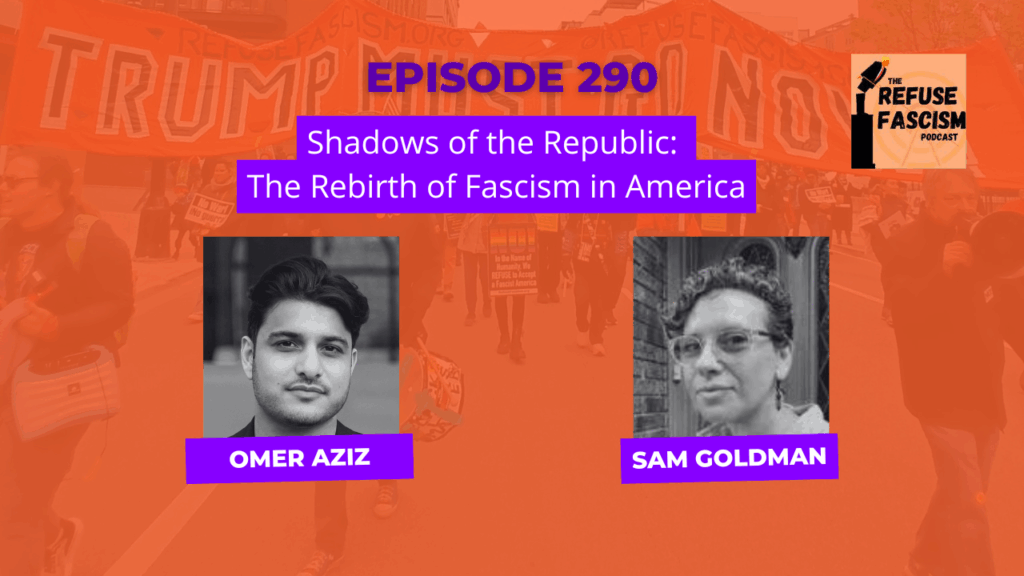
Episode 290
Sam speaks with Omer Aziz, journalist, lawyer, and former foreign policy advisor. His latest book (published April 28) is Shadows of the Republic: The Rebirth of Fascism in America and How to Defeat It for Good. Stephen King wrote, “Omer Aziz has written a book that should be an alarm bell announcing that the American house is on fire.”
Aziz is also the author of Brown Boy, and he has held residencies at MacDowell and Yaddo. Follow his work at omeraziz.com.
The World is Counting On Us – read and share this statement from Refuse Fascism
Text REFUSE to 855-755-1314 or sign up online, follow @RefuseFascism on social media (@RefuseFashizm on TikTok) and our YouTube channel: @Refuse_Fascism.
Support:
- Subscribe to Refuse Fascism on Substack
- patreon.com/refusefascism
- donate.refusefascism.org
- Venmo: Refuse-Fascism
- Buy merch (Big Cartel)
- Buy merch (Fourth Wall)
Music for this episode: Penny the Snitch by Ikebe Shakedown
Shadows of the Republic: The Rebirth of Fascism in America with Omer Aziz
Sun, May 03, 2026 5:59PM • 51:46
Omar Aziz 00:00
Fascism is the shadow of democracy; the need for retribution and revenge, the need for hierarchy, the desire for punishment and exclusion, the desire for glorification and this nostalgic look to the past. Fascism is deeply rooted in America and in the West.
Sam Goldman 00:35
Welcome to episode 290 of the Refuse Fascism podcast, a podcast brought to you by volunteers with Refuse Fascism. I’m Sam Goldman, one of those volunteers and host of the show. Refuse Fascism works to unite all who can be united in mass nonviolent resistance in the streets and throughout society to drive the Trump fascist regime from power. Much appreciation to everybody who rates and reviews the podcast via Apple Podcasts, or wherever you listen, who reps the show with Refuse Fascism merch, who shares the show with others, who follows us on Substack, or, very importantly, is a patron of the show. It makes such a difference, and we hope that after listening to today’s episode, if you haven’t done those things already, or you haven’t done all of those things already, you’ll take a moment to do so after listening.
This week, we’re sharing an interview with Omar Aziz, author of the just released book, ‘Shadows of the Republic: the Rebirth of Fascism in America, and How to Defeat it for Good.’ Stephen King reviewed the book, writing: “Omar Aziz has written a book that should be an alarm bell, announcing that the American house is on fire.”
Sam Goldman 01:48
But first this week has been, in all respects, a terrible, horrible, no good, very bad week for people who care about civil rights, who care about humanity. A week which again, begs the question: Why the fuck are people not acting at the level this moment demands? Is it shock? Is it normalization, taking hold? Are people still telling themselves: This can’t be real, not here, not in America… That somehow, in defiance of all evidence, a savior is in the wings, the regime will implode. There is a magical self correct? I think about this often as we see the harrowing gap between reality and response — on one side, atrocities, a sledgehammer coming down on the rights of Black people that generations fought for — fought for in blood — being ripped away.
On the other, too much quiet, too much adjustment, and in some quarters — fascist ones — gleeful vengeance. Take the Supreme Court. This week in its 6-3 decision, the Supreme Court gutted what was left of the Voting Rights Act, making moot a core provision of the VRA, the very legislation that helped dismantle legalized racial apartheid in this country. Let’s say plainly what this ruling is, what just transpired. A court stacked with white supremacists, has once again cleared the path for suppressing Black political power, reviving a new form the logic that Black people have no rights that whites in power are bound to respect. These modern Klansmen don’t think that Black people should have majority Black congressional districts. These fascists don’t think that Black people should have the right to vote at all. Almost immediately, the consequences hit.
After the ruling, Louisiana officials declared a state of emergency and issued an unlawful executive order suspending the U.S. House primaries to give lawmakers time to redraw the congressional map. In wake of this ruling, Southern states did not wait a beat. They moved to accelerate the stripping away of Black political power, with GOP legislatures rushing to redraw maps to eliminate as many majority Black districts as possible. This is one of the most sweeping attacks on voting rights since Jim Crow, and this is happening as Trump, a man who attempted a coup, who pardoned the insurrectionists he incited in carrying out this coup attempt, who openly vows retribution and then goes and carries it out on the daily, moves, with increasing freedom, with immunity from the highest court in the land. The right to vote is being stolen in real time by those carrying forward the legacy of the Confederacy.
So let’s be crystal clear: Trump and the Supreme Court are illegitimate. This attack on voting rights, this white supremacist attack, is not separate from everything else that’s happening. It is part of the same fascist program. After the alleged assassination attempt at the White House Correspondents Dinner, the Trump regime did not miss a beat in doing what they do best, capitalizing on this violence to advance their cruel and brutal program, moving to revoke green cards for immigrants who participated in pro Palestinian campus protests, turning political speech into a basis for immigration punishment; Trump’s DOJ indicting James Comey again for a social media post demanding Trump’s removal, and in doing so, Trump and his department of justice openly signaling that political opposition is to be criminalized; Trump and Melania calling for the firing of Jimmy Kimmel for a joke; followed by FCC chair Brendan Carr going after Jimmy Kimmel for the same piece of satire threatening ABC, owned by Disney, and then launching a review of Disney’s broadcast license years ahead of schedule.
At the same time, tens of billions more are being funneled into Trump’s ICE Gestapo and Border Patrol, with the participation of the Democratic Party, expanding the very machinery that is already being used to hunt, kidnap, terrorize and then torture immigrants in concentration camps. This is how power is being consolidated, targeting dissent, targeting media, targeting political opposition, while the legal foundations that could check this are being torn up or weaponized into bludgeons of fascist atrocity. This is not coming out of nowhere. This fascism is a product of a system in deep crisis, grappling with global rivalries, climate catastrophe, mass displacement of people and growing instability it cannot resolve on its own terms.
The answer to saving this system for the fascist section of those in power is a more vicious, more lawless form of rule. The Trump fascist regime, while it echoes the slave holding confederacy, Jim Crow segregation and Nazi Germany, has no historical precedent in the scale of destruction it is setting into motion. With the climate crisis at a tipping point, the looming danger of war between nuclear armed powers and a global refugee population of over 100 million people, this regime is a threat to the very future of humanity and life on this planet. Yet, as I said before last week, the streets have been far too quiet. My commenting on this deafening silence isn’t to discount those who are speaking out, who are taking action, or those who did take to the streets on May Day in opposition to Trump.
But seriously, is this a country where Trump can do all this and threaten far worse, show his willingness, and people live with it…hate it, are filled with anguish, stay up at night and worry, but in the morning, learn to live with it? or is this a country where millions refuse an act to stop it? Well, you and I have a role to play in making sure to, as much as possible, we make it the latter, because every day of business as usual normalizes this madness. Every day people stay at home, do nothing, limit their outrage to a social media post, is another day this gets locked in further. Again, it’s not that millions don’t feel the outrage, that they don’t feel the anguish, but many, many people — the majority — are still seeing this through the lens of normal times. They’re being pulled to think of this as the furthest swing of the pendulum, that this nightmare is something to wait out, something we can have a long struggle against, something to resolve through the usual channels.
To do that, they have to downplay the stakes, to tell themselves this isn’t as dangerous as it really is, and hat is a deadly, deadly delusion. Because the regime is moving aggressively to lock in its hold on power. Trump and his minions see the growing anger, and they are acting fast to lock it down. They are working right now to rig the next election, including using ICE as a force of intimidation at the polls. In response to Democratic Party efforts to look into the Trump regime’s moves to demolish election integrity, Trump has called the Democrats treasonous, likening their activity to war. It feels silly to have to say this, but we should take it seriously when the commander in chief describes the opposition party as waging what amounts to war.
This regime is intensifying repression against anyone who stands in opposition. This means liberals, it means radicals, it means revolutionaries. This cannot be met with division or delay. We’ve gotta struggle against it now, with a lot of unity and action among all who oppose it, even as we continue to struggle through our differences in a principled way. So returning to my main point, the momentum and direction of this fascism is clear, but it is not unfolding as smoothly as the fascists would hope. There continues to be widespread disgust for what this regime is doing, including among people within the institutions of power themselves.
The divisions at the top of society are real. It continues to be true that society has not been this divided since before the Civil War. It is precisely because of this upheaval, because of this instability, that there is a basis to drive this regime from power. But that will not happen on its own. It will not happen by waiting for elections that Trump is actively rigging. No, this fascism will not be defeated by relying on Democratic Party midterm affordability politics. It will not happen by shrinking what is an existential threat down to “kitchen table” concerns, which, let’s be real, is like saying the German people should have demanded a better standard of living under Hitler. No, the Trump fascist regime must be driven from power now; not someday, not after more horrors, not after more people adjust, not after the ground to resist is gone, and those who continue to resist, who dare, are locked up, dead or brought to their knees.
No, now. This is possible. What does it actually mean for that to become real? It means this demand: Trump Must Go Now! is spread everywhere — on the campuses, in workplaces, in the arts, in the streets, across every part of society. It means growing numbers of people refusing to go along with business as usual again and again, until millions are in motion around this demand. When people act together, nonviolently, in growing numbers, united around one clear demand, it can change what is possible. It can shake the confidence of those holding things together. In that situation, the divisions at the top don’t stay contained, they are forced open.
Those within the power structures who are already conflicted are enabled and compelled to act, because the country becomes increasingly difficult to govern as it is. The legitimacy of their very system gets called into question on a global stage. That is how a demand becomes a material force in society. That is how regimes lose their grip. So it’s on all of us, you and me, those listening, those who you share this with, those far and wide, who see the danger to step forward now into the streets and throughout all of society, raising the demand Trump Must Go Now! building that relentless, nonviolent resistance that create that can create a crisis. This regime cannot govern through, a political earthquake that compels those who rule to act to legitimately remove Trump from power. With that, here is my interview with Omar Aziz.
Fascism is not something we’re waiting for. It’s not a future threat. It’s here. That’s the argument Omar Aziz makes in his latest book, available now, ‘Shadows of the Republic: the Rebirth of Fascism in America, and How to Defeat it For Good.’ He doesn’t treat fascism as something foreign to the United States, but something with deep roots here in racial hierarchy and state violence, in the ways democracy itself can be hallowed out from within.
The central question of Aziz’s work seeks to answer why and how fascism returned, and how this republic might withstand the forces coming for its downfall. He takes us from neo-Nazis marching through Cambridge openly, brazenly, to the broader ecosystem that sustains them, and he’s clear: Trump didn’t create this, Trump is the expression of it, the culmination of forces that have been building for decades. So if fascism is already here, what does that actually mean? Why is it the form of rule transforming the United States, and why is it not surprising to anyone who understands American history?
How, if at all, does this historical understanding of fascism in U.S. history help us understand what must be done to stop it now, not theoretically, but in practice, like now, like yesterday. To get into that, I’m honored to welcome Omar Aziz, lawyer, author, former Foreign Policy Advisor in the administration of the Canadian Prime Minister, whose latest book, out now, is ‘Shadows of the Republic.’ Welcome Omar. Thanks so much for coming on.
Omar Aziz 13:42
Thanks so much for having me.
Sam Goldman 13:51
So what I always like to start with is, why write this book now? Why are these the questions that you wanted to dig into now?
Omar Aziz 12:30
Well, it’s been a long time coming. Frankly, I started thinking about this book in the fall of 2016, as Trump was getting elected. I was at Yale Law School, at the time, a very democratic, progressive place. We all thought Hillary would win. We thought we were masters of the universe. We thought that liberalism would prevail, always. That turned out not to be the case. Then from 2016 onwards, and it’s kind of insane to think that this November will be 10 years since that election, it just got progressively worse. We saw that with the first Trump administration. We saw that with the neo-Nazis in Charlottesville. We saw that with the January 6 insurrection, and we saw that in the interlude during the Biden years of this kind of far right movement gaining steam.
By the time I was at Harvard in the fall of 2022, I thought I was working on a purely historic book, and then a bunch of neo-Nazis and organized militia kind of or a gang, emerged from the shadows, it would seem, and began protesting right there at Harvard Square. Actually, I think it was the century anniversary of the March on Rome, too, so the timing was uncanny in many ways. That’s when I began to think that this is a much deeper problem than Donald Trump. This will outlast Donald Trump. The forces that produced Donald Trump are still with us, and most worryingly, they are attracting young, diverse followers — mostly men, but also women, people of different ethnic backgrounds, people of different social classes, and they all seem to be coming together under this far right umbrella.
Of course, not all of them are violent. Some of them are fascists in suits, as I call them — different social classes, different backgrounds — and they’re all coming together under this far right umbrella that is fundamentally anti-democratic, and it’s only getting worse. As I saw this pattern continuing, I wanted to delve deeper into the subject. I’d always been reading into it, but I really wanted to go down into the depths of fascism to figure out how we defeat it. What I found was two things. First, that the fascists attracted a lot of people because they were perceived as fun, as if they knew how to throw a good party. The second is that fascism is deeply rooted in America and in the West.
Sam Goldman 14:10
Both of those, when I was reading it, strike me to your point about the attractiveness of the fascists, for someone like me, and I’m sure, like someone like you, most people with a heart for humanity, even if you just think about the way they talk about women, it’s disgusting, and I wonder, How could anyone listen to those things and then say, sign me up? Then, ultimately, I had to struggle with myself about how naive that was, how a lot of people felt a gut punch to find out that, like, 62 million visits to an online rape academy [these reports may be exaggerated], and like the month of February, and then that was increased in the month of March.
And it’s not that surprising. The fact that misogyny is real and attractive is something that we have to confront, and that that is something that for some people, that is fun and it’s incredibly disturbing. It’s hard to wrap my brain around. I was wondering if you had any similar experience while you were doing this work.
Omar Aziz 14:25
Absolutely. I mean, we take these things for granted. We think that, okay, everyone is against misogyny, sexism, racism, Islamophobia, anti-semitism, etc. But that’s often not the case. In fact, fascism attracts people who have largely fallen through the cracks. I’m not saying that there aren’t wealthy people, well off people in the movement. There are, and those alliances are important to understand and to break, but largely the foot soldiers are young men without university/college education, who don’t have a stable income, who are seeing the world move very fast, and now in the cultural sphere, on Twitter, on Tiktok, on YouTube, there’s all kinds of far right trends that make it cool; that glorify fascism and Nazism, that make it seem like this is a counter cultural, interesting movement that you want to be a part of. It’s almost like joining like a club of some kind, an exclusive club.
It’s difficult to tell why Nike sneakers are cool, like, why a trend catches on, but you see this across culture, across politics. From someone like Kanye West in music to Donald Trump, who emerges from the television industry. Let’s not forget, the entertainment industry, one of the most liberal industries, to some of these street fascists that we’ve seen, it’s a pretty diverse collection of people. In fact, Trump’s 2024 coalition was one of the most diverse for a Republican presidential candidate in many, many years. So part of me is like: Yes, it’s angry or it’s upset, but I think a much deeper part that we have to reckon with is why this is going on, and we need to understand why this is going on for us to be able to have some chance at defeating it. That means offering a blueprint forward, offering a way forward, and that begins by recognizing that Nazism and fascism are not some other-worldly, demonic ideologies that emerged out of nowhere. They’re fundamentally part of America and the West
Sam Goldman 15:00
Exactly. I think that that is such an essential understanding, and I want to get into that, but before we do, I wanted to speak to something that I’ve been thinking about a lot. Early in the book, you write very directly: “Fascism isn’t coming to America, it’s already here.” What are people missing, or, more accurately, probably, refusing to see when they still treat this as something looming, something that could happen, instead of something that we’re already living through? If people refuse to see that and confront that, what does that prevent them from doing in terms of a response?
Omar Aziz 17:06
Saying it’s here gets rid of the delusion or the illusion. It gets rid of the lie that America and the West is a fundamentally good place and that fascism is an external threat, rather than fascism being indigenous to America and to the West. Don’t get me wrong, things like constitutional law, rule of law, democracy, equality, these are real. I believe in them, millions of people believe in them. These are the bedrock of our society. But as I say, in the way Carl Jung described the shadow that all human beings carry, fascism is the shadow of democracy.
Fascism is the other side; the need for retribution and revenge, the need for hierarchy, the desire for punishment and exclusion, the desire for glorification and this nostalgic look to the past. They don’t fix anything, but they do promise to fix everything and to offer a way forward, when, historically, the only place they’ve led to is war, annexation and chaos. So I think it’s kind of a comforting opiate of the masses to say that fascism isn’t here, that it’s coming, it’s a looming, it’s on the way. When actually, not only is it here, it emerged here. It is indigenous to here. It came from here. So the Ku Klux, Klan, the Confederacy, the far right militias in the United States, these precede the Fascist Party and the Nazi Party.
Hitler, in his second book, looks to the United States as an example of racial law making, restrictions in immigration law, sterilization laws, laws of segregating Blacks and whites across the states, and, of course, the Klan movement. So a lot of those seeds of fascism were already present in the United States. In fact, Hitler called the United States, at one point, the number one country for racist lawmaking in the world, and he viewed it partially as a Nordic nation. So even the Nazis were looking at the United States not as a constitutional republic, which this year celebrates 250 years, of course, of that Republic, but as a white supremacist nation.
So they looked at the same history that we do, and they drew a very different conclusion. And we need to be able to reckon with that as well, to think about the constitutional convention as this book goes into the Civil War, the post Civil War, the 1920s of eugenics and sterilization and racist immigration laws, and to really reckon with the fact that this has been with us for a long time. And so when fascists in America, in Western countries, talk about the history of the country and racism and so forth, they’re drawing on indigenous traditions, traditions that are indigenous to America and the Western world.
Sam Goldman 21:56
That is such a central element of your book, working with people to understand whether you want to say Fascism is not foreign, or Fascism is homegrown, whatever way of saying it, the basis in this society, the seeds of it, from its founding, the ways that it influenced, as you were just talking about, European fascists, but also, as you have a whole chapter on, basically, how celebrated by tens of thousands in Madison Square Garden, the Nazi Party was, in the United States. I think that we have nothing to gain and everything to lose from refusing to look at American history and to see those seeds.
This is even more important as it’s the 250th you have all the celebrations coming. I live in Philadelphia. They’re already in the works here. And I think it’s really, really important. One of the things that I was wondering from your perspective is: How do you hope that reshaping the way that people understand American history and the danger we’re facing now…if we’re able to reshape that, what could it mean politically, if people are able to do that? If people are able to see that fascism isn’t an aberration here, but the home grown-ness of it, what implications does that have for ideology, politics, morality.
Omar Aziz 23:21
What’s intriguing to me is that so much of this history is right there for people to find, but it’s not something that’s underscored. It’s not something that is considered important. [In] the 1920s the klan was the most powerful political movement in the country. It controlled governorships, Senators. It had some 40 million members all across the country. It was nationwide. It protested out in the open, extremely powerful organization, 1930s there are multiple rallies at Madison Square Garden. The most well known is that 1939 rally with the German American Bund. But even before that, 1934, 1935 they’re having rallies like every year in the Garden.
Why is no one shining a light on this? Why does this not get the attention that it deserves? It seems like a pretty big deal. It was considered a big deal. Then you see it on the front page of The New York Times at the time, or in the 60s, with the Klan, 70s and 80s. So you kind of see this movement that is quite central to American history in the 20th century, and yet we don’t discuss it, or it’s not given the due that it requires. I think the first part is understanding history, understanding that this was central to American history. Second part is understanding it’s not the whole story. It is part of the story. It is a reaction to the positive story. But it’s there. Its shadow is half of the identity of the United States. What are the implications for politics?
First, you have to understand a problem to be able to address it. Then you can begin addressing it through the root causes. Fascism is a cause of a lot of our instability — democratic breakdown, polarization, violence, etc. — but it’s also a consequence, it’s also a symptom. It’s a symptom of two decades of war, sending young men to die and destroying communities in America and in the Middle East as well. We killed a lot of people in the Middle East. We also destroyed communities in the United States. If a family loses a family member, that community is destroyed forever; the economic crisis that we have never recovered from; mass inequality people in this gig economy, no stability or security. That’s a massive, massive change as well, mostly impacting millennials and Gen Z.
The social changes that we have seen — very, very fast, social changes that we have seen around identity, around culture. What fascism offers people is a membership into the elite, of a kind, and a tool of power. If you might not be at Harvard, or you might not be in the White House, or you might not be on Wall Street, you might not be in Hollywood, you might not agree with these institutions, but if you join this fascist club, you could stick it to the man. You could take power. You could seize power. That’s what the fascists did in the 1930s as well. We should never lose sight of how desperate… or never lose our appreciation for how people who become really desperate will respond to ideologies like this.
Sam Goldman 26:03
This was a point that you made, in your last answer, you touched around this, and earlier in the conversation that I wanted to return to, you make the point in your book, and here in this conversation about the movement becoming more diverse. This is something that really is puzzling to people. I don’t want to overstate this either, and this may have changed since the election in terms of levels of support, but more people of color, more women, even LGBTQ people, in some cases… I’m wondering if you could just share your thinking on how you explain them being drawn into an ideology that not only historically and structurally targets and dehumanizes them, but right now, targets and dehumanizes them.
Omar Aziz 26:52
Yeah. I think it shows the modernism of the movement as well. Fascists understand what the demographics are. Yes, racial discrimination, gender discrimination, in theory, are really important, but recruiting members is more important. So the leader of the AfD in Germany, for example, is a lesbian woman. The number of far right influencers in America, a number of them are minorities and from minority backgrounds. It was a paradox at first, but it’s not so much when you think about it. So even a minority man or LGBTQ, whatever you have, someone who’s not from the traditional circles of power, that person already has dealt with exclusion, that person has already dealt with discrimination. Maybe they’ve been excluded from these institutions.
Let’s not forget, mainstream institutions in America were not exactly friendly towards Black people, brown people, immigrants, LGBT for a long time. Let’s not let the last ten years color the last 250 years. Progress took a long time for us to reach, and even then, there’s still lot more work to do. If you’re an individual in one of these communities, there are many people who have been left behind — your friends have been left behind. It’s not enough to say: Well, let’s wave a rainbow flag if you can’t get a job and your friends are being excluded and don’t have opportunities, and the liberals and the Democratic Party becomes a corporate party.
Let’s not forget that happened as well. It was less of a paradox as I researched it more, and I just found that minorities, LGBTQ, women, they’re no different. They’re also human beings, they also feel the same things that we all do, and it would make sense how people who have not gained or been offered power before, except often as a transaction for voting, would suddenly be welcomed into this movement that says we’re going to return power back to you, or we will take power from the institutions and the people that never had your best interests at heart. That’s a very appealing message to a lot of people. Let’s be clear, women are not the majority constituency of the fascists, LGBTQ are not, but they make up increasing chunks of this movement.
And it shows you that the movement is becoming more powerful because it can appeal to diverse followers, because it can build a bigger tent, because it can welcome these people into its movement, and because it’s smart and clever. You cannot build a mass movement with only white men in 2026. That’s not how it’s going to go. We saw evidence for this in the Trump election in ’24, where increasing numbers of minority men, for instance, voted for Donald Trump. This is a trend that’s going to continue. It’s the same thing — it’s because minorities and LGBTQ community members and others are also human beings, and when human beings have been left behind or excluded or told they don’t matter, and the other side is only offered slogans, at some point, they will give a shot to the fascists where they might belong. It’s only a matter of time before people who have been excluded and fall into the cracks and feel left behind, would find the fascist message appealing. It’s emotionally appealing. It’s satisfying. It’s based on revenge. It’s based on getting back at people who harmed you, and that’s why the movement is growing.
Sam Goldman 29:54
You describe this as a new fascist era, not in the U.S. alone, but globally, and you spoke some to this already in our conversation, but I wanted to see if there was anything else that you wanted to share about what makes this moment qualitatively different from previous, for lack of a better phrase, right wing surges.
Omar Aziz 30:16
It’s a good question. I think technology has changed significantly, so those messages of far right nationalism can be amplified. We have a chapter the Dark Arts of Propaganda, that envisions what would happen if Joseph Goebbels had social media. So he would have access to the algorithms, artificial intelligence, all these tools, including military tools, to be able to influence the masses. I think economic collapse is another factor that’s different now than it was before. I think that the scale of corruption that’s been revealed in America and other countries. You see this with the Epstein files. You saw this in the wars in Iraq and Afghanistan. You saw this with a financial crisis.
The scale and scope of the corruption is almost unfathomable to regular people. So if you’re a person working a nine to five job, and then you see the Epstein corruption, you see the financial crisis corruption, you see insider trading, at some point you’re going to feel like you’re being scammed, and people who feel like they’ve been scammed are not exactly hopeful, optimistic, democratic citizens. They get very upset, rightly so in many cases. So we’ve seen a perfect confluence of factors here. And one important thing that we haven’t discussed enough is just how the Democratic Party failed — how it failed its workers, how it failed its base, how it failed its constituents, how it failed young people, and it became a constituency of elite corporate interests, which, yeah, they might enjoy putting up a black square on Instagram, but they don’t want to make the substantive changes that would get regular people the change in the progress that they need.
They’d rather tinker around the edges and then do their insider trading, or whatever it is that they do. But part of this is Kamala losing in ’24 and Hillary losing before that, and that system, as well, being rigged against people who want to challenge the status quo, like Bernie Sanders and others. Effectively, we’ve had a one party system where one party has gone far right, and the other party has been willing to be a junior partner in that, and has had no courage whatsoever.
So I do think this is a unique moment in that respect, and that what Trump did is he took a sledgehammer to all those norms and the facade of democracy and inclusion, and he said: Actually, this is the real face of America. There’s something about that truth telling, even if it comes from a venomous place where, in an era of so much bullshit, when someone speaks the truth in that kind of way, will be very appealing to you. That’s how Donald Trump was able to flip states that hadn’t gone red before. It’s how he was able to build a diverse coalition of people. Until we address that, until the left, Democrats, centrists are able to actually tell a better story, have substantive plans and policies and speak to those people who have been left behind, not just elite corporate interests, we’re gonna stay in this mess.
I think that actually we’re not going to go anywhere until we have generational change in politics and in leadership. So until you have more Zorans and AOCs and Ro Khannas and new leaders emerge — the Chuck Schumer’s and the Nancy Pelosi’s are not gonna get us out of this mess. They got us into this mess. They’re the reason, partially, we are in this mess. We are going to need generational change, new leadership, new political visions, new mass movements and grassroots organizations. But we’ve gotta pass the baton now to millennials and Gen Z. Gen X and the baby boomers, they had their chance, and they messed it up, frankly.
So now we are in the situation that we are in, with potentially cataclysmic consequences for the rest of my life, and the rest of young people, younger people’s lives. So until we have that generational change in leadership, we’re gonna keep going down this line, because older generations, they had it a lot easier. Since the 90s, a lot of these trends that I’ve described — war, financial crisis, etc, democratic breakdown — they’ve just continued on pace, and then Trump emerges from the scene and takes advantage of it all. We see with the Epstein files, the hollowing out of American institutions and private brokers and the lack of trust.
I think a lot of people of my generation, who are millennials and younger, basically, they don’t take anything that the older generations in politics say seriously. It’s like an ‘Okay, Boomer’ kind of thing. So until we have that change of leadership and change in generation, it’s not going to be easy. But that is necessary, a necessary prerequisite, for us to challenge fascism and offer a way forward that builds a better society. Because resistance is half of the solution here. Resistance is 50% of it. The other half is offering a positive, hopeful, optimistic, democratic plan forward that sustains a good quality of life for future generations and rebuilds democracy from the ground up.
Sam Goldman 34:39
I appreciate you taking on both parts of it. What makes this moment different in terms of technology and propaganda and the different ways that this can spread, as well as your view on why the Democratic Party isn’t fighting the way that fascism needs to be fought. I personally think that they’re not fighting — and this is not the opinion of everybody in refuse fascism, listeners or anyone but my opinion is they’re not fighting — this the way it needs to be thought, because they are part of the same system, and they can care much more about stability of their system than they do about fighting fascism. I think that your way of saying that, the junior partners in this enterprise, is something that definitely stuck with me.
Because we all have to reflect on the reality that fascism doesn’t just advance because of the fascists, it advances by all those who enable, who facilitate, who who accommodate to it. Which, let’s be real, y’all, includes most of us right now. So I really appreciate that full picture. There was this one line in your book that I felt resonated so deeply and was so contrary to so much of fascism literature that’s out there that also I feel like speaks to, you know, our conversation about this new era of fascism. You write a whole section, there is perhaps no one more all American than Donald Trump. In the same way that, like so much discussion is how fascism is an aberration to America, there’s also the idea that Trump is an aberration to America. I was wondering if you could just speak a little bit to that.
Omar Aziz 36:25
Yeah, that is so false. It’s cope. It’s false on its face. Donald Trump is born in New York, German immigrants, he inherits money, he’s goes to an Ivy League school, he is in television entertainment industry, reality TV, he loves McDonald’s, he doesn’t exercise — this guy is as all American as it gets. Even his look, I mean, the blonde hair. And of course, if you look at it, electorally, he won more votes in the first Republican primary in 2016 than anyone who had ever run in the Republican primary. Then he beat the greatest political machine in a generation, the Clinton machine. Then he does this insurrection, gets impeached twice, but then he comes back as well. So his movement clearly was sustainable and was real. It wasn’t just like a one time thing.
I think the Trump election in ’24 should have put those arguments to rest, that he’s an aberration of any kind. Clearly, he is more of the mainstream than we’d like to admit. There were threads of Trumpism in the past with Pat Buchanan and Ross Perot and other candidates. So I view Trump as a central mainstream figure of American history. There are many others like him, populists and such, Andrew Jackson, for example, populists on the left as well. So Trump is one piece of this, but I think the movement that he has unleashed is another piece. I don’t think he, deep in his heart, has those ideological fixtures that, for example, Hitler did. I think he’s mostly an opportunist. He has some of the typical American New Yorker racism — that’s there, but I don’t think he is in the same category as a Hitler, for example.
Now, with that said, he has won two elections, he’s won multiple primaries, he has a devoted, loyal fan base, he has young people who like to watch him… He’s also suited for the social media age, the age of clips, the age of off color humor, the age of attack ads. So fundamentally, Trump is part and parcel of the American mainstream. The question is: Why did everyone miss this? We didn’t see it coming. We thought it was a joke, and then confronted with it, we’ve been unable to defeat it, twice. So that’s why I think Democrats lost to Trump twice.
Not to get too political in the day to day politics, but now you’re talking about running Kamala again. It’s just like they learn nothing. They learn nothing, and they mortgage our futures, young people’s futures, in that it’s going to take the people, of fascism — who would be its first victims — to unfortunately carry that burden and to step up and to lead, with lots of allies and lots of good people; you see the No Kings protests across the country, you see protests going back to 2016, 2017 against Trump and for a progressive movement.
But again, going back to what I said earlier. You cannot just fight against something, you have to offer people a vision for something. Get people excited and hopeful for your vision. What is it that we are offering? What is it that we are going to give people? What are the changes that we are going to implement? Why should people support liberals and centrists and common sense conservatives? Why? What’s the plan? To just deregulate the economy and sign more free trade deals and have AI wipe out all our jobs? do the exact same thing we’ve been doing for 30, 40, years. Is that what we’re going to do get a Democratic president and get someone like Larry Summers to be the economic advisor, to tell them that, yeah, let’s cut regulation and make our wealthier friends wealthier. All that is ultimately counterproductive.
I think we need a grassroots movement. We need a movement based in integrity and truth. When there is so much telling of lies, when there’s so much mendacity, when there’s so much anger, when there’s so much duplicity, telling the truth is a radical act. We should begin there. We should begin by telling the truth of how we got here and where we are going. We should begin to offer people a vision grounded in truth, in justice, and yes, in love as well, if I may — that speaks to people and champions their hopes and dreams and offers them a vision and says that we’re stronger together if we build this thing together. I know things are not easy, but we’ll get there. Our vision is long term, unlike the fascism, which is a reaction. I think if we can do that, we’ll be okay, but it’ll take some time, some effort and new imagination for us to get there.
Sam Goldman 40:25
I was wondering, if you were writing this book today, what would you add based on what’s changed? What has surprised you? There’s not a predictiveness in your book. You’re stating what is…larger realities that undergird it. But would there be anything that, based on over a year in power, that you would have changed?
Omar Aziz 40:47
Yes. I finished writing the book late last year. I started it in 2021 as a project, and I’ve been thinking about it since 2016, to go back to where we began. I wanted to write this book in a way that would outlast Trump, and that wouldn’t matter who won the 2024 election. So something I was surprised by is how quickly the machinery of terror has been implemented. The ICE agents, for example, the deportations, the military on the streets, like how quick that was. That’s one thing that surprised me, but then really shouldn’t surprise me.
Then, I wanted to focus on the earlier stages of fascism. I didn’t want to go into World War II as much, because that’s been written about to no end. So how did the fascist movement begin at the early stages? How do they begin to take over politics? One thing that has surprised me, or that I would focus on more today if I was working on, was the foreign policy of fascism, because expansionism, aggression, illegal wars, are part and parcel of fascism. The book touches on this — Mussolini’s invasion of Ethiopia, Hitler’s invasion of Austria, etc., Czechoslovakia — but it’s not the main focus of it.
If we look at fascism today, at the threats to Greenland, you look at Venezuela, you look at my country of Canada…the threats being waged against Canada, for instance, and then against Europe, against allies in the Middle East, there’s a war going on, a pointless, reckless, ridiculous war going on in Iran right now. So the kind of military aggrandizement, expansionism and imperialism is fundamental to fascism, and I would probably focus a little bit more on those threats as well. Granted, the expansionism in the foreign policy emerges from the domestic policy. So fascists breakdown society, or there’s breakdowns going on.
Fascists seize power, and they have this ideology — we’ll make Germany great again, let’s say — and then one way forward, the easiest way forward, is, let’s start invading our neighbors and expanding our territory, expanding our land. Because who doesn’t like that? Even though, long term that leads to collective warfare and suicide. So that has been fundamental to this version of fascism as well, the kind of Neo imperialism that we are seeing, the rules don’t matter, we can go back to illegal wars of aggression, but that also stems from the fascists at home, the domestic politics, the gaining of power, everything that the book goes into.
The foreign policy ends up becoming an extension of that. Fascism in one country means fascism everywhere, because everyone, everywhere, has to deal with the consequences of it. Maybe your country has been invaded, annexed. Maybe you’re being threatened. Everyone buys goods and services that are tied into this global supply chain, so prices go up for everyone. We all feel pressur. As soon as it emerges in one place, everyone is threatened by fascism in all places.
Sam Goldman 43:35
Really, really appreciate that. It’s been something that we’ve been discussing a lot: What is the relationship between smashing international law and domestic? Is it only, or primarily, a mechanism to enable repression at home, or is it something else? Which I think is traditionally how a lot of people view it. There’s definitely a piece of that, but I think that there was a lot more in the way that you were sharing your analysis.
Omar Aziz 44:04
They’re the same thing, because if you’re gonna do violence at home, you will do violence abroad. If you don’t take domestic law seriously, you will not take international law seriously. If you view humans and minorities and vulnerable people as disposable within your own country, citizens, then of course, you will view them as disposable when they are not citizens. Unfortunately, when we go into these trend lines again, we have to mention it, just the drone warfare under the Obama presidency, the wars in Iraq and Afghanistan under the Bush presidency.
In some respects, George W. Bush, despite being a more moderate New England Republican, was a more violent president than Donald Trump was. We don’t want to get into these comparisons, because for different reasons, they’re both awful in many ways, but wars in Iraq and Afghanistan killed hundreds of thousands of people. The deregulation sprees in the 90s. I mean, some of this might have been good for business, but much of it was extremely harmful for workers. The globalization phenomenon, free trade deals, where so many jobs are going abroad. We should do free trade, but we should also look after workers here.
If a politician has signed away a contract, free trade deal, that makes you lose your job and livelihood, your family lose their job and livelihood, your neighborhood to be hollowed out, drug addiction to spread, that’s a form of violence as well. So this has been building for some time, and I think Trump just entered into the presidency, and he was like: Holy, I’ve got so many powers that other presidents didn’t used or use in a more limited way — I can invade countries, I can impose tariffs, I can fire whoever I want, I can send the military in…and much of this has legal justification. So we paved the road for Trump to get there and for fascism to emerge, partially by supporting all these things when it was in our interests, and partially by looking the other way or being bystanders, or not wanting to rattle the status quo. That is how we’ve gotten to this point, and that’s why it’s going to take more than an election or an election cycle to get us out of it,
Sam Goldman 45:58
Absolutely. I think that that is so important, and, if you’re betting on a dude who tried to steal an election, who tried to, have a coup, who then pardoned all the coup participants to uphold an election that he loses? Come on, get real man! The part in your book, your conversation with Raskin and imagining what would happen if they had succeeded… People are not thinking that way. People are thinking that this is something so past — ‘this’ being the coup attempt — that it is so far in the past, instead of seeing how far they’ve advanced that agenda since then.
That’s why, when people talk about how this will be solved through an election, I think not only is it grossly overestimating what the Democrats would do, it is grossly underestimating what the fascists would do, I feel, on both points, I want to thank you so much for taking the time to talk with us about your book and for sharing your expertise and your perspective. I did want to say one thing. I wanted to put a pin in for listeners to think about the youth and Gen Z. I think that out of any other demographic, they’ve actually sat out the most in this presidency, in this regime.
Personally, I think that has a lot to do with the fact that these young people watched a genocide be live streamed for years by both political parties in this country. They watched them shut down campuses. They watched their friends be arrested for protests. They saw that despite their cries to stop the genocide, that their government didn’t give an F. I don’t think that they unfortunately walked away with the best synthesis of what happened. There was a lot of demoralization there. So I think that there’s a lot that the young people can do, should do, and need to do, but I think that we also have a lot to do for them as well. I just wanted to put that out there for people to think about. I know that, as somebody who goes out to the campuses a lot, there’s a lot of hopelessness, there’s a lot of despair. That’s why I pose the question about hopelessness and despair, because it’s deep. It’s deep.
Omar Aziz 48:15
There’s also a lot of positive energy, though. There’s a lot of positive energy, there’s a restlessness and anxiety to make change happen, to get on with it. You’re right, the live streaming of the genocide and the kind of helplessness that we saw…that will scar Gen Z for the rest of their lives. That will be the defining kind of trauma of many of their lives. But look, we have to look forward to do we want to keep going down this route or not? When I meet with Gen Z, when I speak at college campuses. First of all, there’s a huge excitement to discuss this issue. It’s like, finally, we’re going to have this conversation that we’ve been avoiding.
But secondly, there’s a real optimism, a stick to it, ness, a grit, that they just kind of want to get to it and start building and improving, because they recognize that they’ve been failed by past generations. Rather than us sugar coating it, let’s just call it for what it is, and let’s get on with it, because time is limited and I’m optimistic. The book ends with optimism and hope. I remain optimistic and hopeful that we will fix this, we will get through it, and we will build something better, but only if regular people step up.
Sam Goldman 49:15
Absolutely. Thank you so much, Omar Aziz, for taking the time to shine the light on the danger — to go there so that we can defeat it. For listeners, go and get the book. You can buy it, I believe, wherever you buy books. Do you want to talk about anything else, Omar? about where to get Shadows of the Republic?
Omar Aziz 49:36
Yeah, you can buy it anywhere. It’s published by a smaller press, because a publisher had to take a bet on this book when it looked like fascism wasn’t going to happen, so I encourage listeners to buy it wherever you can get it from, Amazon, bookshop.org, your local bookstore as well. It’s called ‘Shadows of the Republic, the Rebirth of Fascism in America, and How to Defeat it for Good.’ Thank you.
Sam Goldman 49:57
Thanks for listening to Refuse Fascism. In the Name of Humanity, Trump Must Go Now! The world is counting on us! Join Refuse Fascism, building a movement across the country that is clear on the problem, Trump fascism, and serious about stopping it through mass, nonviolent struggle, united in the demand: Trump Mist Go Now! Support the show by becoming a patron at patreon.com/RefuseFascism, subscribing to our sub stack or picking up Refuse Fascism merch. If you live in a place with a lawn, be sure to get a lawn sign, get a few, give them to neighbors, give them to friends, give them to family.
You can also support the show for $0, you can make a real difference by sharing this episode, rating and reviewing it on Apple Podcasts or your listening platform of choice, subscribing for free to our Substack,, and recommending our Substack to others. Be sure to stay connected and get involved at RefuseFascism.org and on social media @RefuseFascism. You can also text REFUSE to 855-755-1314, to stay in the loop on actions and developments. Much appreciation to Richard Marini, Lina Thorne and Mark Tinkleman for helping produce this episode. Until next time, In the Name of Humanity, We Refuse to Accept a Fascist America!